.webp)
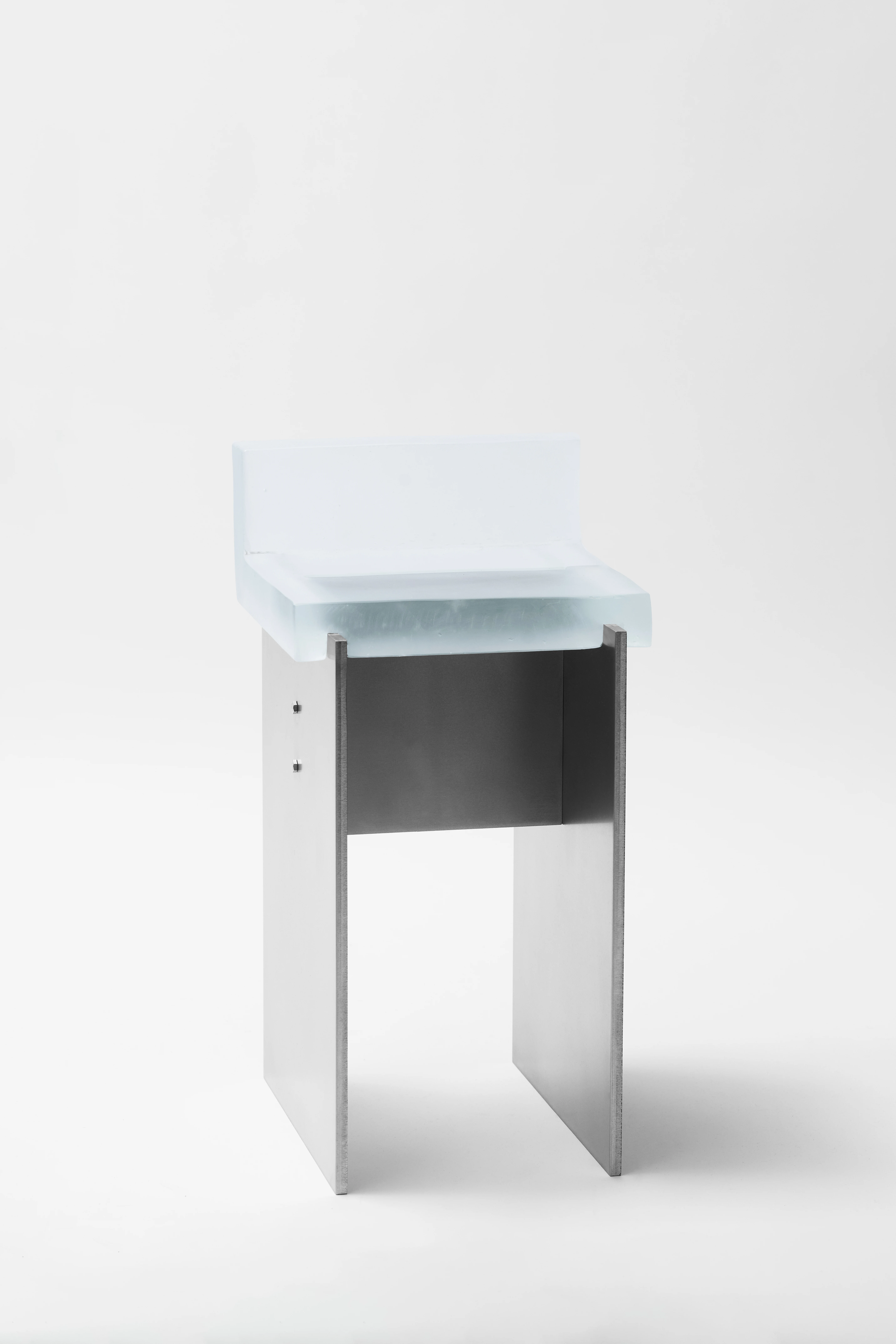
From Berlin, Obscure Objects and Studio Maximilian Beck produce Rest Chair, a seat of large-scale cast glass resting on a minimal stainless steel frame through weight alone.
The piece begins with an unusual premise: two Berlin practices, each working in a different material register, agreeing to build something neither could make alone. Obscure Objects, the collaborative design practice founded by Luisa Pöpsel and Moritz Pitrowski in 2023, works in metal fabrication and has long been drawn to the unexpected in everyday form. Studio Maximilian Beck has developed a specialisation in experimental large-scale glass casting, a process that resists precision and demands a tolerance for the unpredictable. Their exchange produced Rest Chair, and the T-Table that accompanies it.
The glass component is cast in an imperfect mould, which means every seat carries the evidence of its own making: faint clouding where air held, a granular surface texture where the molten material met a boundary it could not fully fill. Seen from the side, the seat-and-backrest form reads as a single thick slab, pale blue-grey like sea ice in diffused light. Edges and corners are chamfered by hand, softening what would otherwise be a hard orthogonal block. The colour shifts depending on viewing angle: from directly above, the seat surface becomes almost white; from low angles, the glass turns a denser teal.
The stainless steel base is laser-cut flat sheet, folded into a U-form with a cross-brace panel fixed by two visible hex bolts on each side face. There is no concealment here. The screws are the detail, not an afterthought. The frame carries the glass not by gripping it, but by receiving it: the glass sits in a channel at the top of the steel and is held primarily by its own weight, which runs to approximately forty kilograms per unit. That tension, between a material people associate with fragility and a fixity achieved through mass alone, is the structural argument the chair is making.
The companion T-Table follows the same material logic but shifts the visual register. The table surface, also stainless steel flat sheet, extends well beyond its base on both sides, producing the cantilevered silhouette that gives the piece its name. Photographed alongside the chair, the two objects read as a family: same palette of near-white glass and matte grey steel, same insistence on showing how the thing is made, same deliberate placement in the territory between furniture and sculpture.
Each chair is handcrafted and made to order, a constraint that is also a design position. The casting process cannot be scaled without losing the surface variation that makes the glass readable as glass rather than plastic or resin. Obscure Objects describe their practice as one driven by a joined interest in unconventional approaches and finding joy in the unexpected. The Rest Chair earns that description not through novelty of form but through the specificity of how its two materials meet: one poured, one cut, held together by gravity.