.webp)
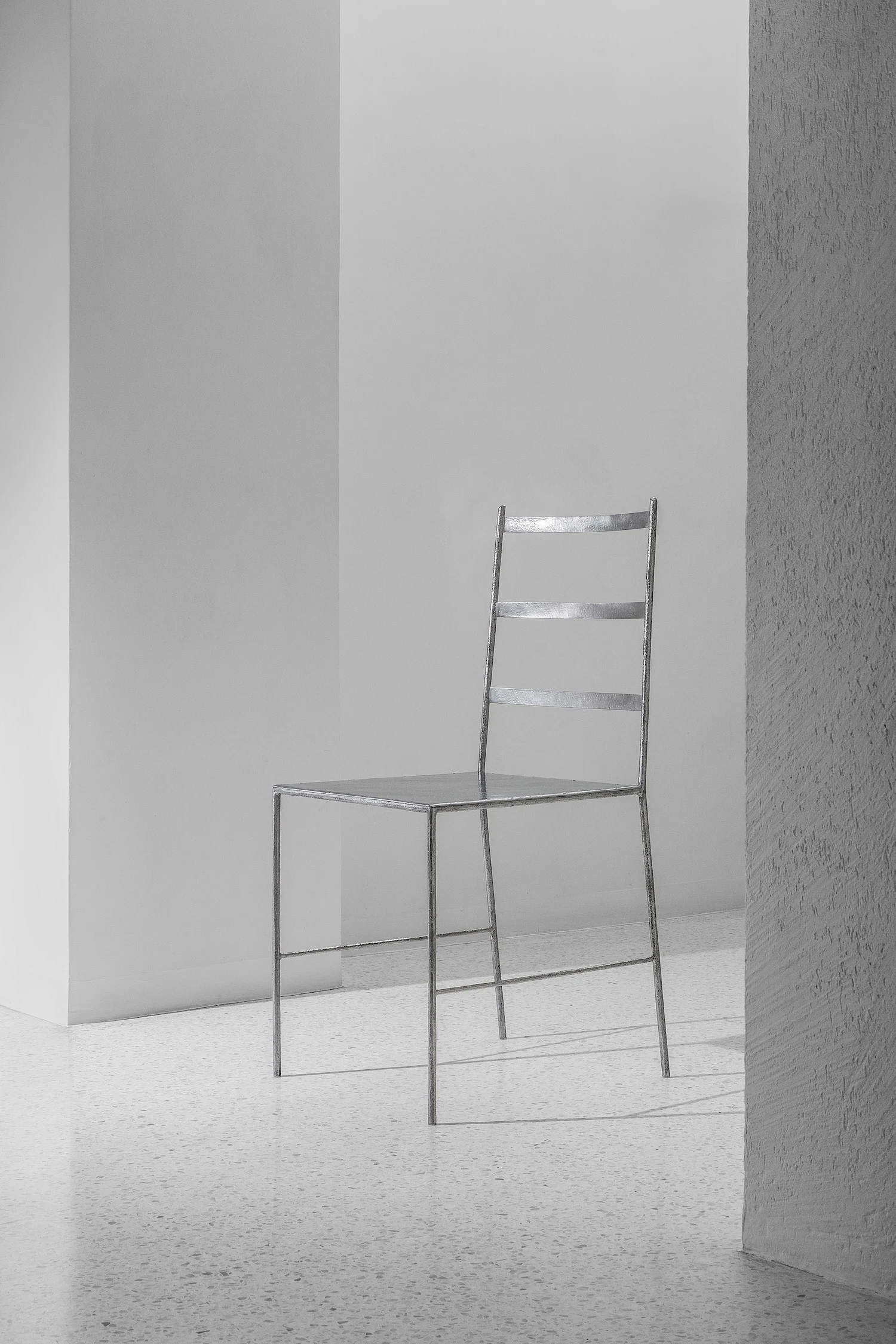
For Giustini/Stagetti, Marie-Anne Derville produces the Serena Chair in hand-forged burnished stainless steel — a piece that holds the legacies of Jean-Michel Frank and Donald Judd in productive tension.
Jean-Michel Frank spent his career makichng luxury objects whose surfaces absorbed light rather than reflected it — rooms of parchment and shagreen and pale velvet that registered wealth through restraint. Donald Judd made objects whose industrial specificity left nothing to interpretation: the steel or the plywood or the anodized aluminum was exactly what it appeared to be. The Serena Chair occupies the space between these two positions without resolving it, which is precisely where its interest lies.
The burnishing process is what holds these references together. Stainless steel, left polished, is demonstrative, hard, reflective. Burnished, it develops what Derville describes as "a matte luminosity that absorbs rather than reflects light" — while remaining entirely, unambiguously metallic in the way Judd's work always insisted upon. The hand-forging adds further dimension: slight irregularities that distinguish it from machined production, introducing a body into what might otherwise be pure formal geometry.
The form of the chair is resolved with comparable discipline. The structural logic is visible and complete; there is no decorative addition, no element present for softening effect. And yet the chair does not read as cold. The burnished finish changes in different light conditions, and the hand-forging introduces the kind of slight variation that makes the object feel inhabited rather than installed. The piece is intended, Derville notes, "for thoughtfully curated interiors rather than commercial applications."
Giustini/Stagetti has consistently commissioned work that treats the collected object as philosophically serious. The Serena Chair belongs to that position — a piece that rewards the kind of extended looking that most contemporary furniture design does not survive.