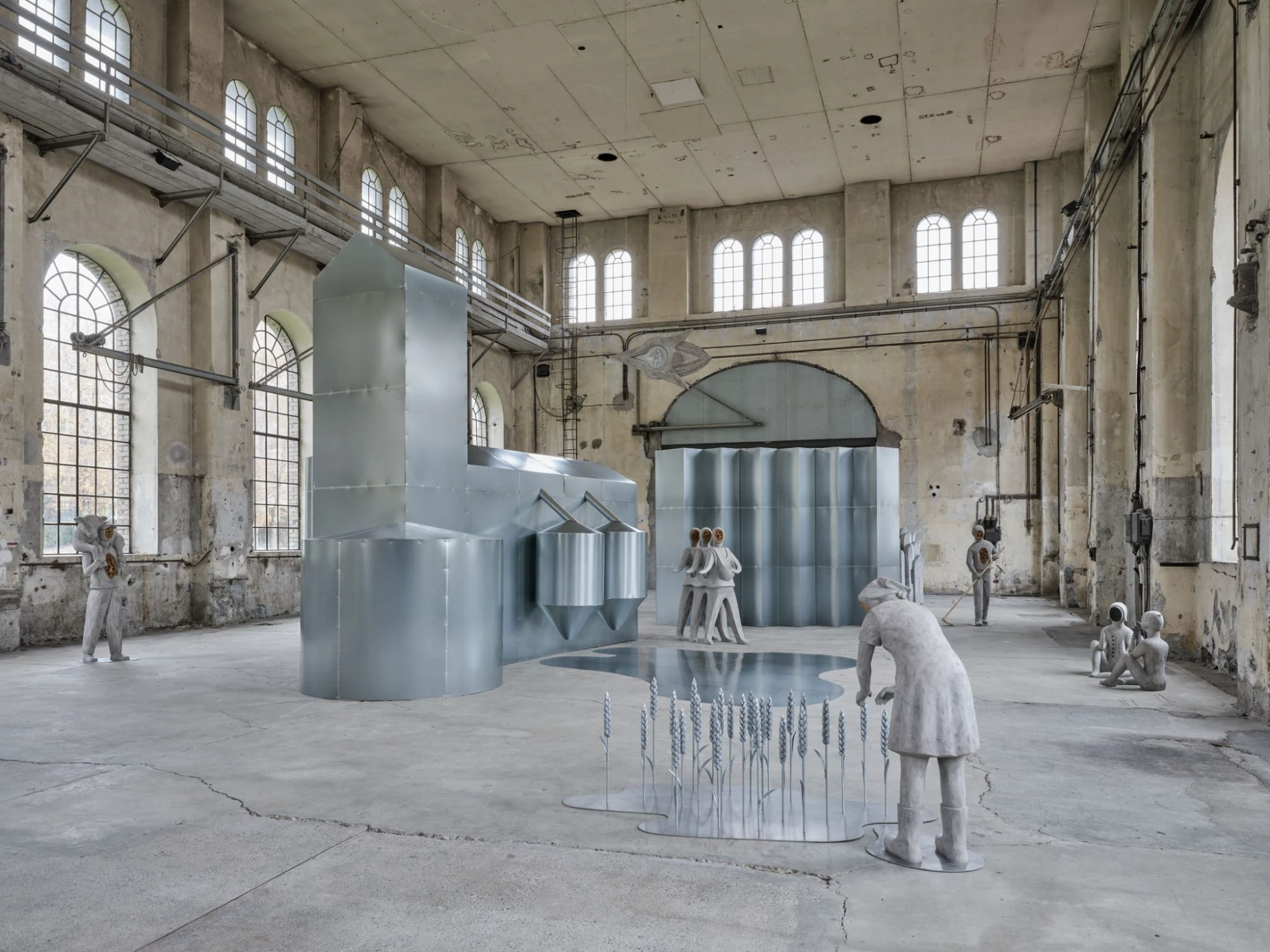
At Kunstraum Dornbirn in Austria, Anna Hulačová's "Bucolica" transforms the historic industrial assembly hall into a stage where ancient myth and speculative futures converge under the sign of agrarian life.
This is not simply an exhibition of sculpture, but a total environment—part pastoral vision, part industrial ruin, and part sacred rite. Hulačová draws on the allegorical framework of bucolic poetry to reimagine the countryside as a site of ideological contest, where the past and future of labour, nature, and technology wrestle for shape.
The architectural intervention is a silent yet towering presence in this narrative. A cluster of metallic buildings—sheet metal silos, naves, and towers—anchor the space with the monumental gravity of agrarian functionalism. Their forms echo Le Corbusier's 1933 admiration for agricultural structures as modern temples, but here they are stripped of utopian sheen. Instead, they house scenes of strange communion: bodies locked in tasks both timeless and enigmatic, machines of ambiguous utility, and gestures frozen in concrete. This imagined farmstead is not productive, but contemplative, suspended between parable and post-human condition.
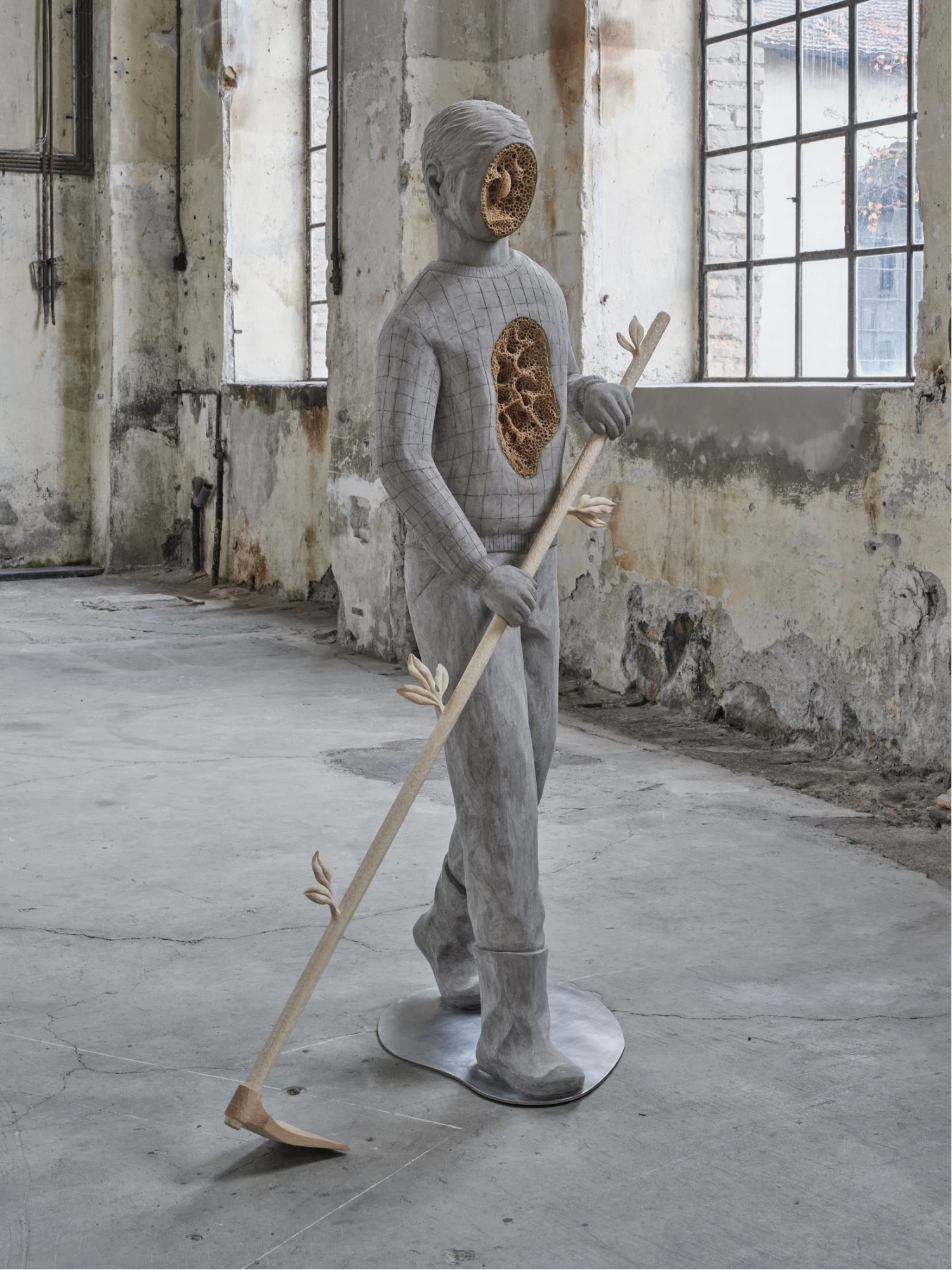
Hulačová's figures, rendered in rough grey concrete, resist humanisation. Their features are displaced by glazed ceramics or schematic ink drawings; limbs taper off into abstractions; organs dissolve into honeycomb. In a poetic inversion of ecological process, her sculpture "Calf Bearer" was partially colonised by bees during its outdoor gestation. The use of living organisms, and reference to "bugonia" myths of rebirth from animal carcasses, folds the sculpture into a continuum of decay and regeneration. These hybrids of human, animal, and insect invoke a deep time beyond the anthropocene—a world in which nature not only survives industrialism but metabolises it.
Against this backdrop, figures like "The Man with the Hoe" or "Jester with Toaster" become emblematic. The former evokes Socialist Realist tropes of glorified labour but undercuts them with subtle disfigurement; the latter infuses humour and fatalism into the mix. A jester bearing a toaster suggests both absurdity and prophecy, as if to say that even in dystopia, the domestic rituals of nourishment and chance persist. Hulačová is not nostalgic for either collectivist pasts or rural idylls—rather, she sees them as tools to excavate deeper tensions between community and individualism, subsistence and spectacle.
The logic of agriculture here is not about production, but about cosmology. Fields are not ploughed, but symbolised. Machines do not function, but gesture. Everything is imbued with the aura of necessity and futility. Hulačová invites us to think of agricultural architecture not only as infrastructure, but as myth-making apparatus—as sites where stories about human survival, power, and sacrifice are staged. Her built environment resists utility, opting instead for ambiguity and ritual.
"Bucolica" is thus a quiet epic. It traverses the continuum from Virgil's shepherds to Corbusian idealism, from folk motifs to futuristic drones, from mythic fecundity to capitalist fatigue. It questions whether the land—and by extension, the built structures that claim to sustain it—can ever be ideologically neutral. In Hulačová's hands, architecture becomes sculpture, sculpture becomes ecology, and agriculture becomes a deeply coded language for human hopes and failures.