At Galerie Mennour in Paris, Nicolas Lebeau presents Would you wear my eyes?, a solo show that turns the ornamental syntax of urban defence into a counter-archive of opacity and refusal.
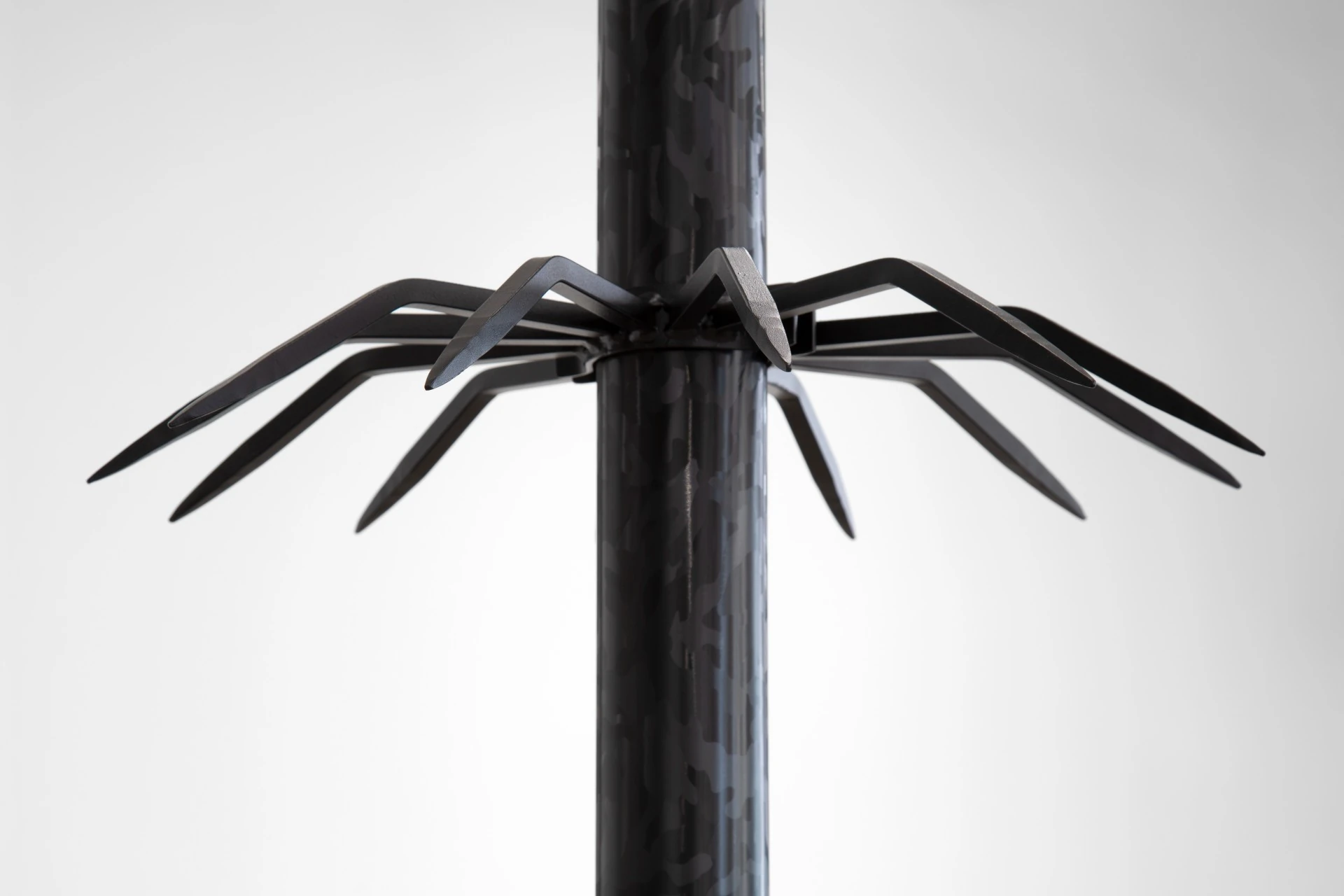
Every city has a second skin: spiked battens bolted to low walls, Mosquito emitters caged behind mesh, camouflage wraps that discourage climbers. This is the grammar Nicolas Lebeau lifts out of the street and into the gallery, where the first thing visitors meet is a black steel column suspended from the ceiling, hooped with sharpened spider-legs designed to deter bodies that would rather not be read. Guillaume Blanc-Marianne, who wrote the accompanying text, calls it the "ornamental syntax sustaining the greyness" of contemporary cities.
The column is wrapped in urban camouflage, its base pooled onto a black rubber mat that warps across the floor like spilled tar, studded with green and amber bottles. Some stand upright, others are melted at the neck, shoulders flattened into impossible curves. Everyday refuse, reformulated by heat into ritual offering. Nearby, under windows onto the first arrondissement, Eye for an Eye stretches a length of anti-climb steel and rubber across the floor, flanked by a rail of further glass detritus.
On the walls, the /zZZzZzz/ and /hex/ series hold the argument. These are photographs Lebeau took between France and Brazil, run through printers he has tampered with until the machines misbehave. Corridors break into vertical strips, figures in red stand in half-finished São Paulo brickwork, a hand clasps a shoulder above a lime-green jacket. The prints are hung on steel rails, floated inside plexiglas crates, or half-drowned in camouflage vinyl; the image is made heavy, slow, resistant to the scroll.
The damage is the point. Following Hito Steyerl's defence of the "poor image," Lebeau works with pictures whose flaws exceed their legibility. Some come from clandestine workplaces and migrant neighbourhoods; others are harvested from Telegram channels that archive global protest before broadcast cleans it up. Sealed in camo vinyl, they become what the artist calls a "safe value of opacity": visible enough to register, illegible enough to evade the absolute Eye of the State.
Counterweights accumulate. Five turquoise-edged plastic crates, borrowed from sound-deterrent cages, march along a white corridor, each trapping a black-and-white fragment of a face behind its grid. A work titled Anything you loose by being real is fake loops a 24-second sound piece made with Paola Avilés, its frequency drawn from Mosquito emitters that target the adolescent ear. In smaller rooms, inkjet portraits dissolve into motion blur or slip into chiaroscuro.
Elsewhere Lebeau turns toward fire, printing volcanic night scenes and coal-lit vigils in the deep reds of a Brazilian Pentecostal community guided by a pastor friend. Framed beside the surveillance objects, these works read as a held "no" to the profane language of quantification. The question he leaves in the press text is the one the whole show keeps asking: do the monitoring devices protect anyone from danger, or do they invent it?