Thisispaper Community
Join today.
Enter your email address to receive the latest news on emerging art, design, lifestyle and tech from Thisispaper, delivered straight to your inbox.
Oops! Something went wrong while submitting the form.
Instant access to new channels
The top stories curated daily
Weekly roundups of what's important
Original features and deep dives
Exclusive community features
Hitoshi Arato
May 5, 2026

Near Ghent in East Flanders, CAS Architecten builds Villa WIGO through an unusual collaboration — two couples, two sets of architects, two generations — producing two volumes in an L that fuse a concrete living pavilion with a dark timber barn.

The name WIGO is a contraction of the project's owners, and the collaborative structure is embedded in the building's logic: one side was designed by Anton Gonnissen and his wife Inge (the owner-architects), the other by Pieter-Jan and Jovanca from CAS Architecten. Two generations working on the same project, two formal languages in negotiation, and an L-plan arrangement that makes the resolution visible — each volume reading as itself while the ensemble reads as one.

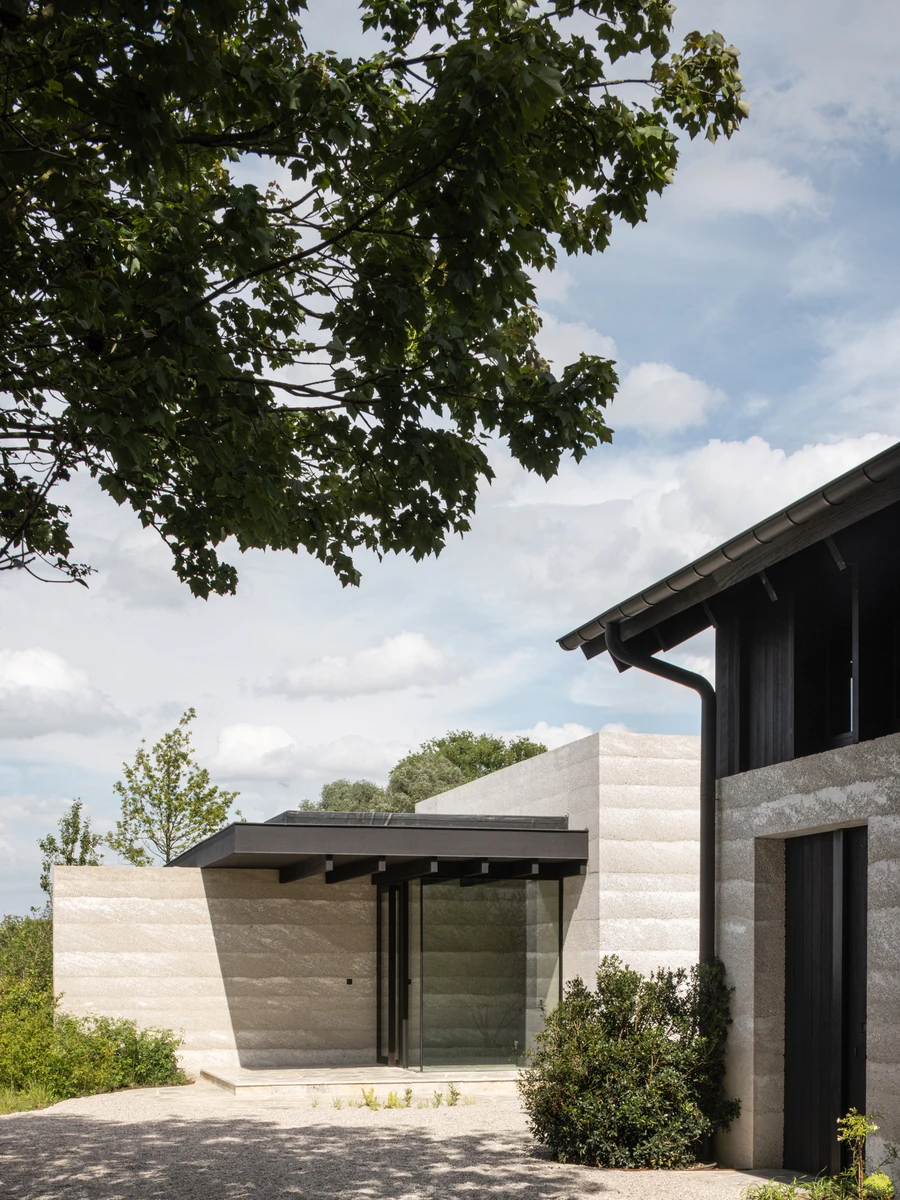
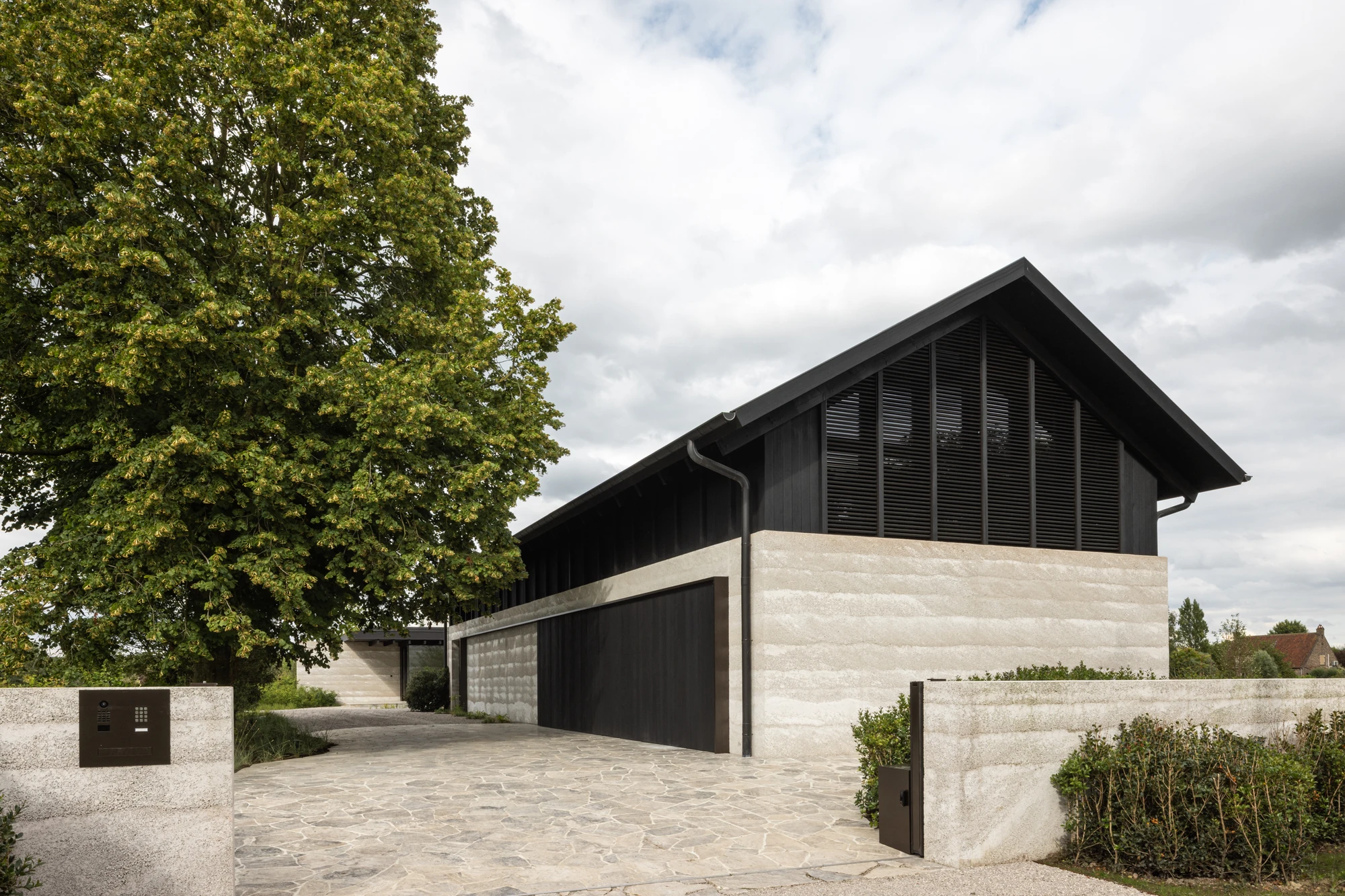
Seen from the road, the first volume positions itself perpendicular to the street as a reinterpretation of the classic barn typology: simple in form, dark in material — charred or black-stained timber cladding at the upper register — and assigned all non-residential functions and building services. The decision to concentrate the technical and service content of the house in this barn volume is a liberating one: it frees the second volume, the living pavilion, from any dead surface area, allowing every room to connect directly with the outdoor spaces and the views beyond the L-shaped front courtyard.

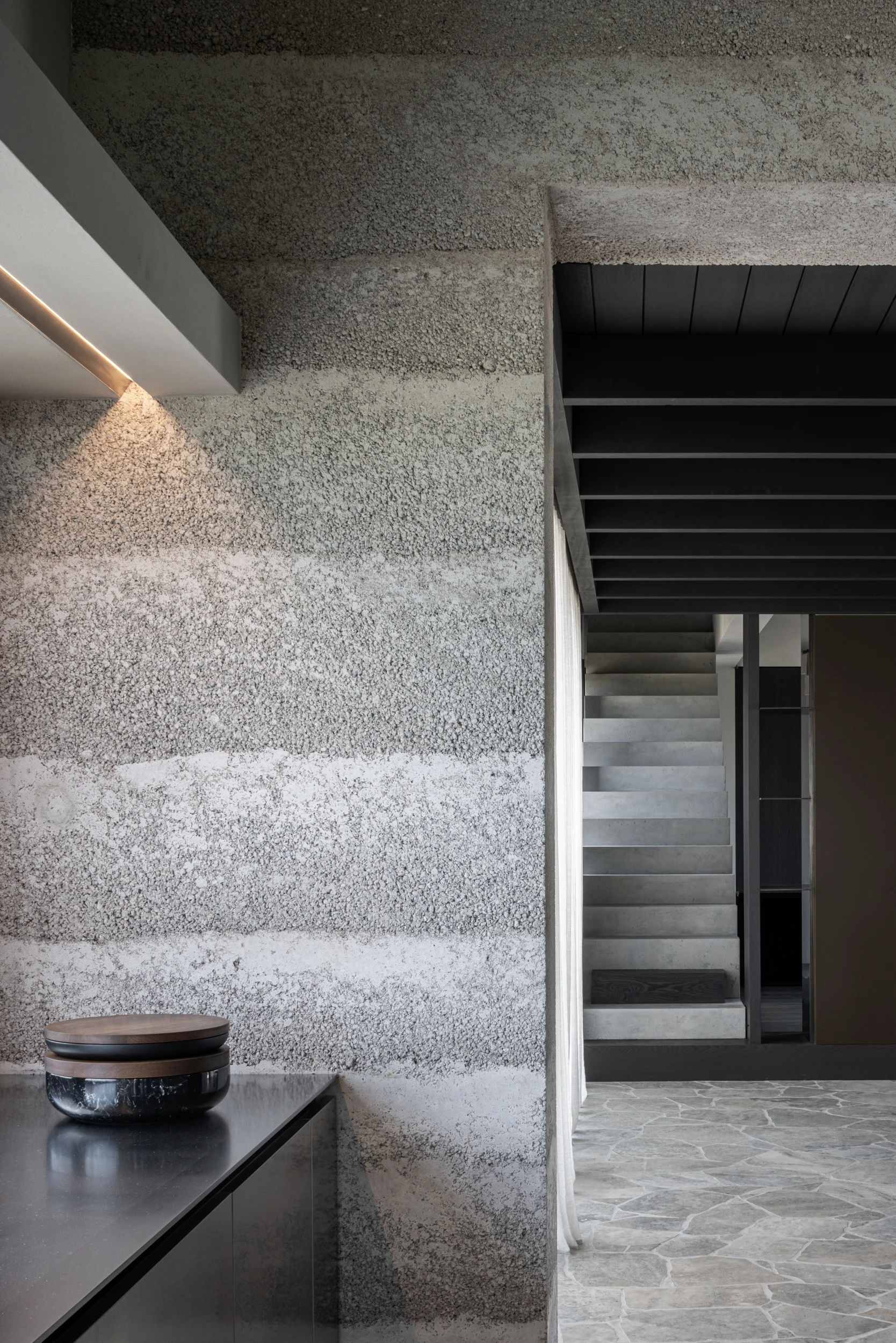
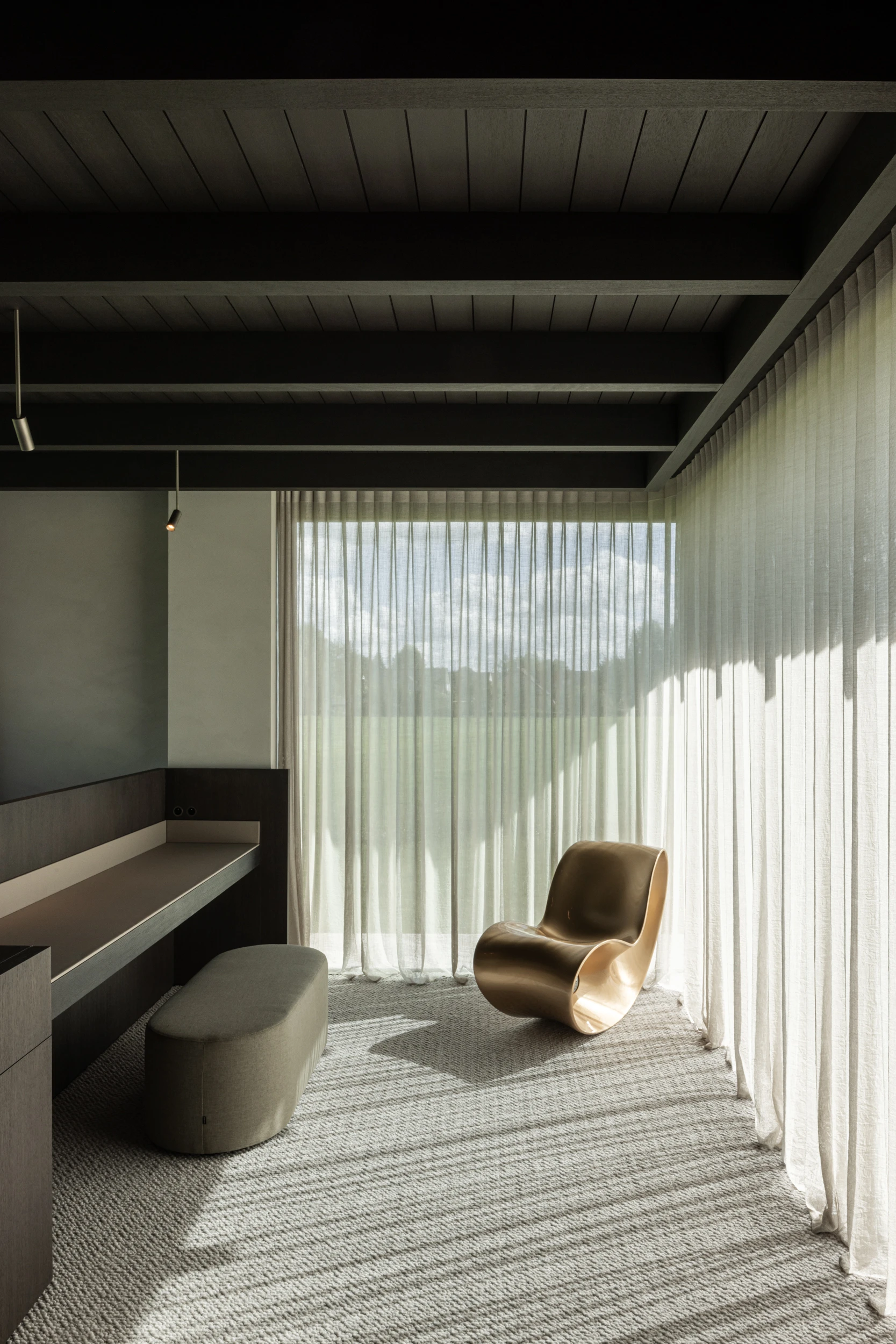
The living pavilion is constructed in concrete — a material whose mass and continuity contrast with the dark timber of the barn but whose palette remains in the same family of restrained, mineral tones. The interaction between enclosed and glazed spaces in the living areas is the spatial event of the interior: glass corners, large openings, the play between containment and transparency that Belgian residential architecture has developed with particular consistency over the past decade. The gravel courtyard enclosed by the L provides a semi-private outdoor room that the two volumes share.

Tim Van de Velde's photographs make the most of the Belgian light — overcast but directional, the kind that gives concrete its most compelling quality: dense and shadowless at once, surfaces registering time rather than spectacle. Villa WIGO is a project about what happens when the brief is genuinely shared — when the client and the architect are not in opposition but in a collaboration complex enough that the result carries the marks of more than one intelligence.
Interested in Showcasing Your Work?

If you would like to feature your works on Thisispaper, please visit our Submission page and sign up to Thisispaper+ to submit your work. Once your submission is approved, your work will be showcased to our global audience of 2 million art, architecture, and design professionals and enthusiasts.
No items found.
We love less
but there is more.
Become a Thisispaper+ member today to unlock full access to our magazine, advanced tools, and support our work.
Get two months FREE
with annual subscription
We love less
but there is more.
Become a Thisispaper+ member today to unlock full access to our magazine, advanced tools, and support our work.
Get two months FREE
with annual subscription
No items found.
Hitoshi Arato
May 5, 2026

Near Ghent in East Flanders, CAS Architecten builds Villa WIGO through an unusual collaboration — two couples, two sets of architects, two generations — producing two volumes in an L that fuse a concrete living pavilion with a dark timber barn.

The name WIGO is a contraction of the project's owners, and the collaborative structure is embedded in the building's logic: one side was designed by Anton Gonnissen and his wife Inge (the owner-architects), the other by Pieter-Jan and Jovanca from CAS Architecten. Two generations working on the same project, two formal languages in negotiation, and an L-plan arrangement that makes the resolution visible — each volume reading as itself while the ensemble reads as one.

Seen from the road, the first volume positions itself perpendicular to the street as a reinterpretation of the classic barn typology: simple in form, dark in material — charred or black-stained timber cladding at the upper register — and assigned all non-residential functions and building services. The decision to concentrate the technical and service content of the house in this barn volume is a liberating one: it frees the second volume, the living pavilion, from any dead surface area, allowing every room to connect directly with the outdoor spaces and the views beyond the L-shaped front courtyard.

The living pavilion is constructed in concrete — a material whose mass and continuity contrast with the dark timber of the barn but whose palette remains in the same family of restrained, mineral tones. The interaction between enclosed and glazed spaces in the living areas is the spatial event of the interior: glass corners, large openings, the play between containment and transparency that Belgian residential architecture has developed with particular consistency over the past decade. The gravel courtyard enclosed by the L provides a semi-private outdoor room that the two volumes share.

Tim Van de Velde's photographs make the most of the Belgian light — overcast but directional, the kind that gives concrete its most compelling quality: dense and shadowless at once, surfaces registering time rather than spectacle. Villa WIGO is a project about what happens when the brief is genuinely shared — when the client and the architect are not in opposition but in a collaboration complex enough that the result carries the marks of more than one intelligence.
Interested in Showcasing Your Work?

If you would like to feature your works on Thisispaper, please visit our Submission page and subscribe to Thisispaper+. Once your submission is approved, your work will be showcased to our global audience of 2 million art, architecture, and design professionals and enthusiasts.
No items found.

Join Thisispaper+
Unlock access to 2500 stories, curated guides + editions, and share your work with a global network of architects, artists, writers and designers who are shaping the future.
Get two months FREE
with annual subscription
Travel Guides
Immerse yourself in timeless destinations, hidden gems, and creative spaces—curated by humans, not algorithms.
Explore All Guides +
Submission Module
Submit your project and gain the chance to showcase your work to our worldwide audience of over 2M architects, designers, artists, and curious minds.
Learn More+
Curated Editions
Dive deeper into carefully curated editions, designed to feed your curiosity and foster exploration.
Off-the-Grid
Jutaku
Sacral Journey
minimum
The New Chair
Explore All Editions +
Atlas
A new and interactive way to explore the most inspiring places around the world.
Interactive map
Linked to articles
300+ curated locations
Google + Apple directions
Smart filters
Subscribe to Explore+
Become a Thisispaper+ member today to unlock full access to our magazine, submit your project and support our work.
Join Thisispaper+Join Thisispaper+
€ 9 EUR
/month
Cancel anytime
Get two months FREE
with annual subscription