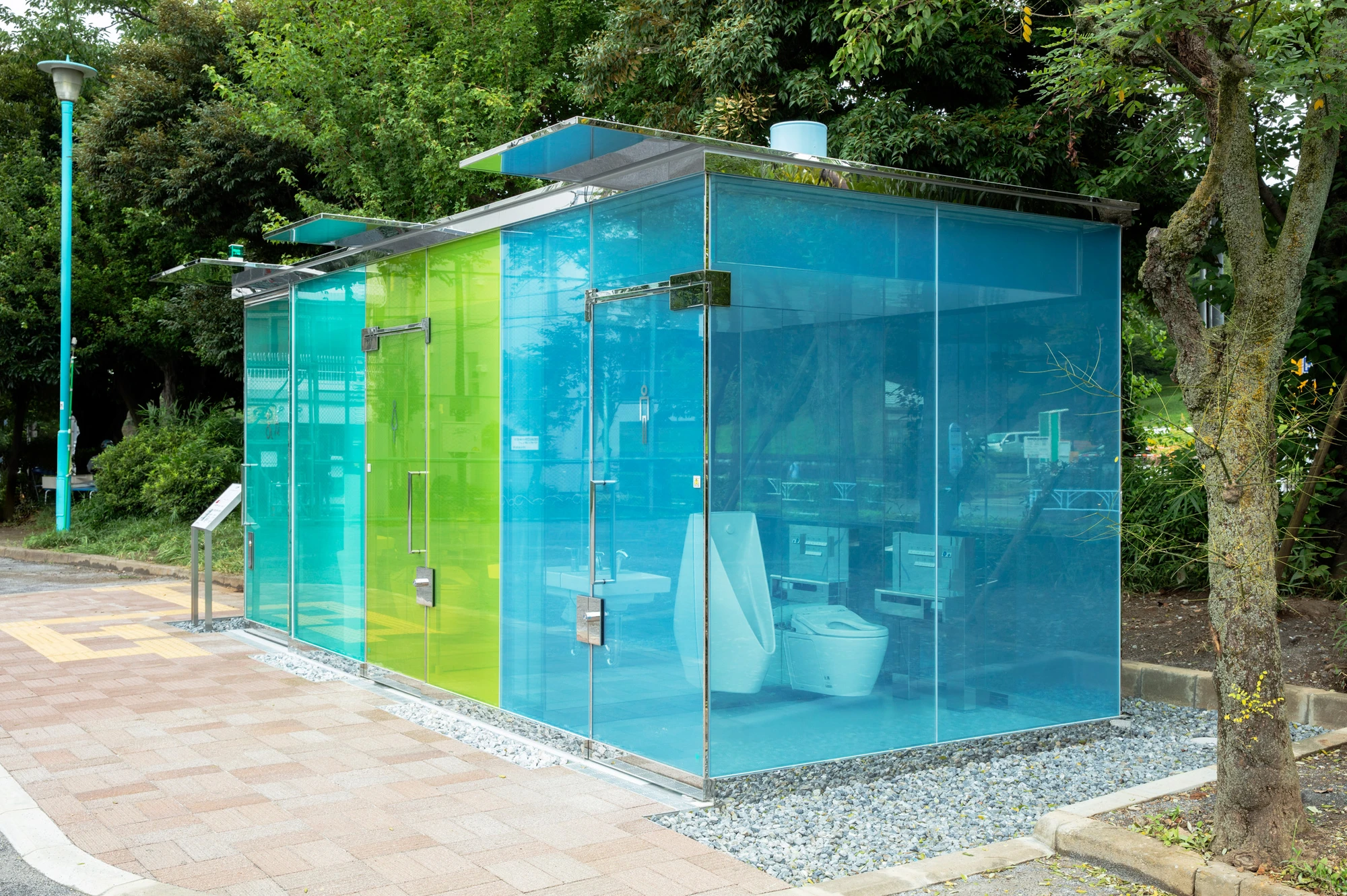
In two small parks flanking Tokyo’s Yoyogi Park—Yoyogi Fukamachi Mini Park and Haru-no-Ogawa Community Park—Pritzker Prize winner Shigeru Ban has designed public toilets that solve two anxieties with a single material decision. The walls are transparent coloured glass, allowing passersby to see that the facilities are clean and unoccupied before entering. Once the door locks, the glass turns opaque.
"There are two things we worry about when entering a public restroom, especially those located at a park," Ban explains. "The first is cleanliness, and the second is whether anyone is inside. Using the latest technology, the exterior glass turns opaque when locked." The technology is simple in concept—liquid crystal film embedded in the glass switches state with an electrical current—but its effect on the experience of a public toilet is transformative. You know what you are walking into before you walk into it.
Each facility comprises three separate cubicles divided by mirrored walls: a male, female, and accessible toilet. Both structures follow the same design, differing only in the colour of the glass. At Haru-no-Ogawa, green and blue hues complement the surrounding trees. At Yoyogi Fukamachi, shades of orange, pink, and purple take their cue from the playground equipment nearby. The colour choices are precise rather than arbitrary—each building belongs to its specific park.
At night, the facilities light up like lanterns, contributing a warm glow to parks that would otherwise be dark. It is a quiet inversion: a public toilet becoming a source of ambient beauty rather than something to be hidden away. Part of the Nippon Foundation’s Tokyo Toilet project alongside contributions from architects including Kengo Kuma, Tadao Ando, and Sou Fujimoto, Ban’s pair of transparent toilets remain among the most discussed—proof that radical transparency, when handled with care, can make the most mundane programme feel like a gift to the city.