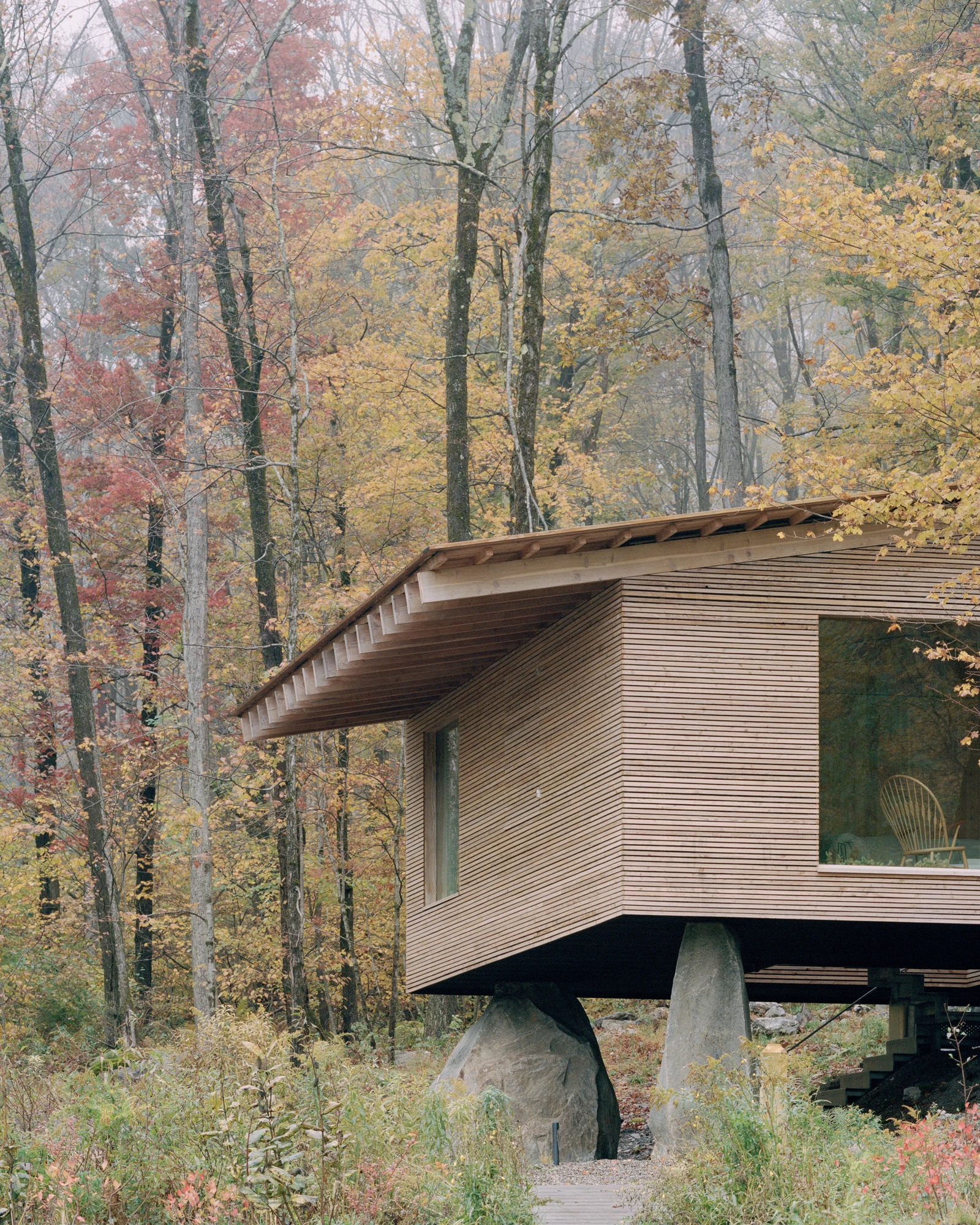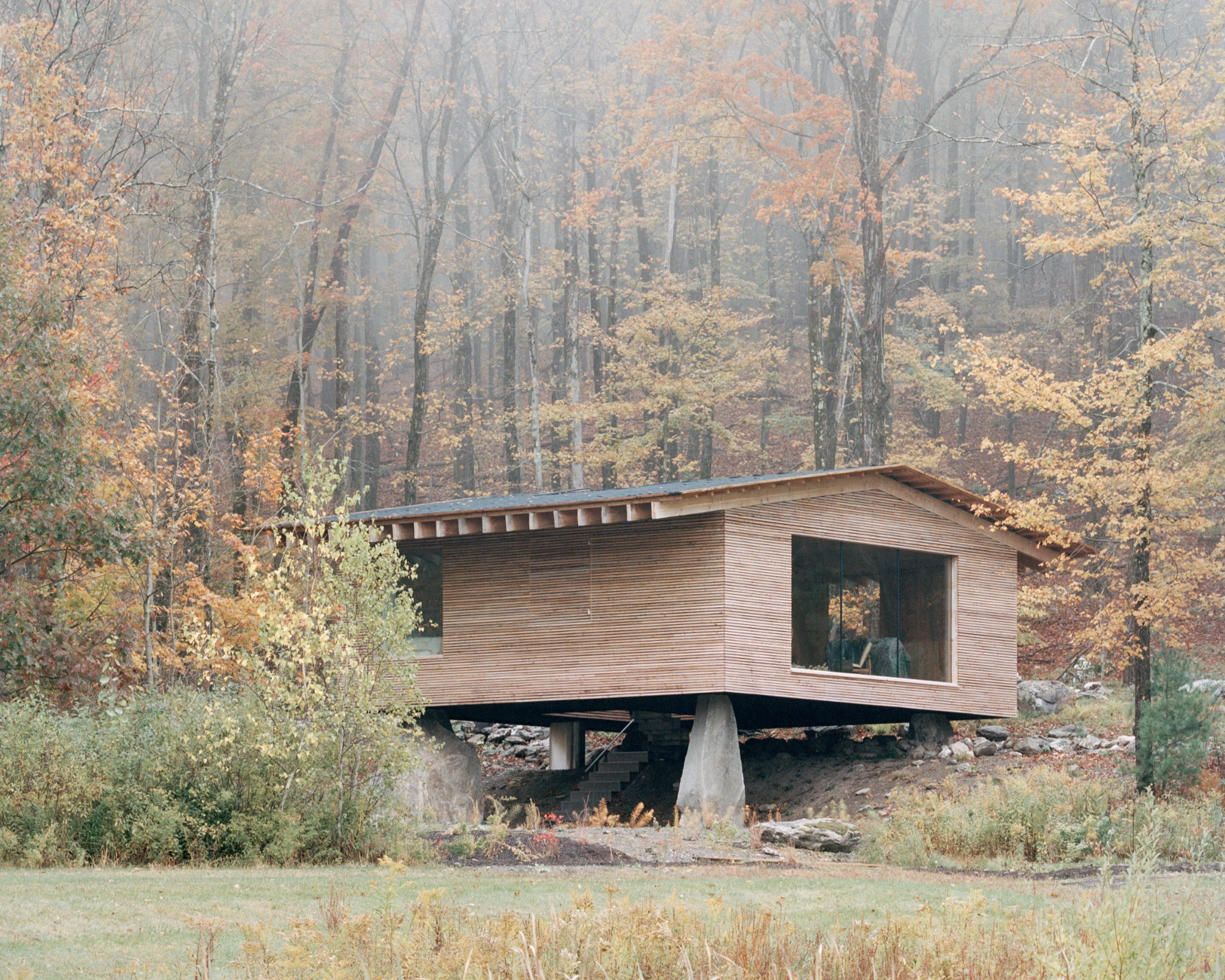
In Austerlitz, New York, Of Possible builds The Findling on four 500-million-year-old glacial erratic boulders, a larch house with no front door whose entry drops you directly into the middle of the plan.
The clients are two Manhattan psychoanalysts. After a previous build left them estranged from their property in Austerlitz, they came to Brooklyn-based Of Possible asking for a retreat that would be restorative in its design and in its making. The 980-square-foot result reads less as an addition to the land than a rediscovery of it, a writing room and occasional guest house lifted just clear of the forest floor.
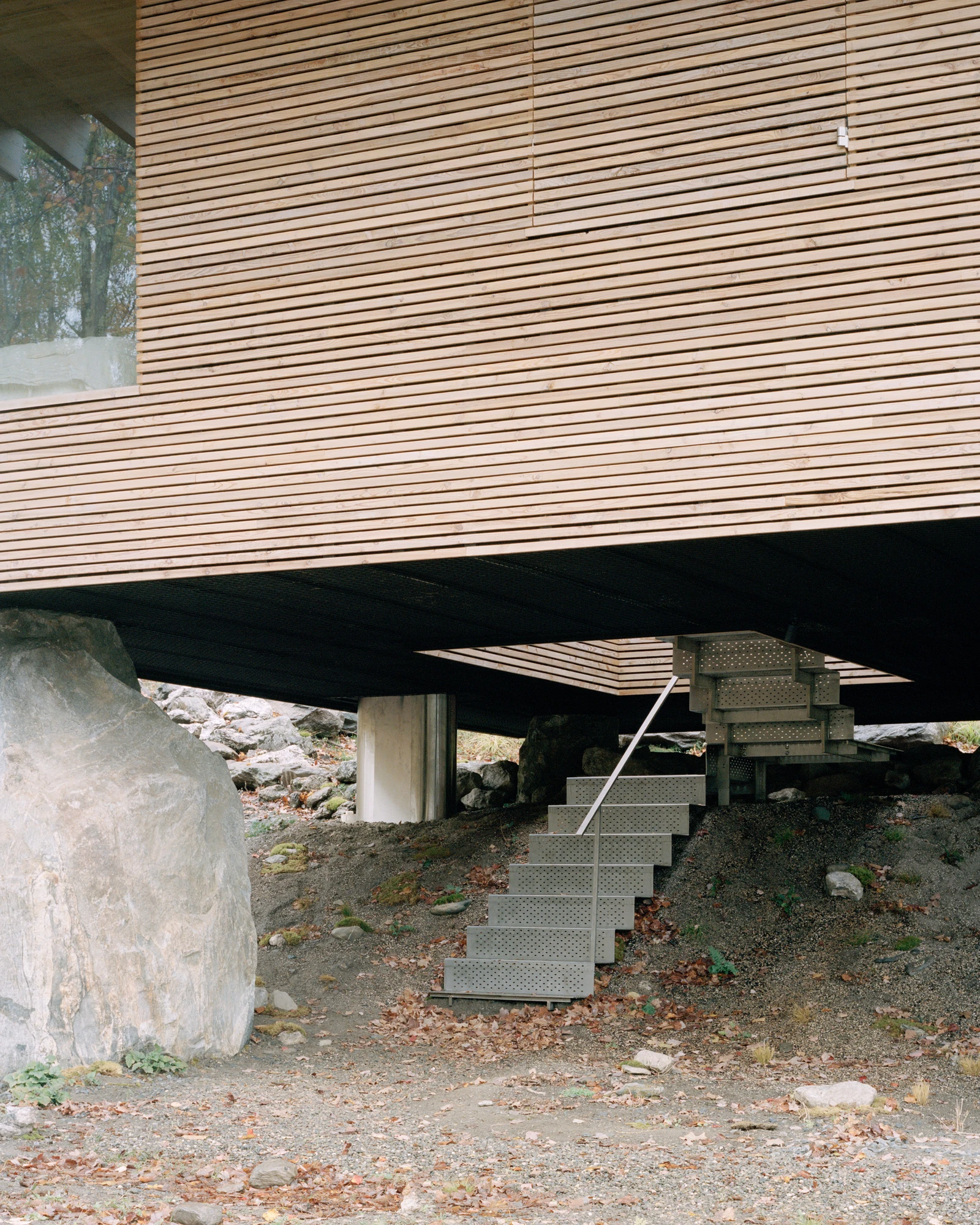
Three elemental parts hold the project together. The dwelling is built almost entirely from larch harvested in nearby forests, chosen for its durability, warmth, and what Vincent Appel calls spiritual clarity. Four glacial erratic boulders carry the load. A thin stainless-steel stair forms the vertical threshold between ground and building. Wood, stone, metal, choreographed as a sequence the body moves through before any door is reached.
The name carries the project. In German, findling means both orphan and glacial erratic, a term a visiting philosopher friend used when he identified the supporting stones on site. Literally, the home rests atop four findlings. Metaphorically, the word names a process of emotional restoration, a way of resetting the clients' relationship to this site and to the act of building. Half the structure also sits on a New England stone wall likely laid between 1770 and 1830, when the land was first cleared for farming.
The stair, Of Possible's "third space," was engineered through finite-element digital analysis and reduced to its thinnest possible expression. It reads as neither of the earth nor of the building. Custom-perforated treads and a ribbon-like handrail introduce tactile cues that make the climb register as a deliberate departure from the path through the woods. There is no exterior approach to a front door. Visitors arrive directly into the center of the plan, into what the studio describes as an embrace.
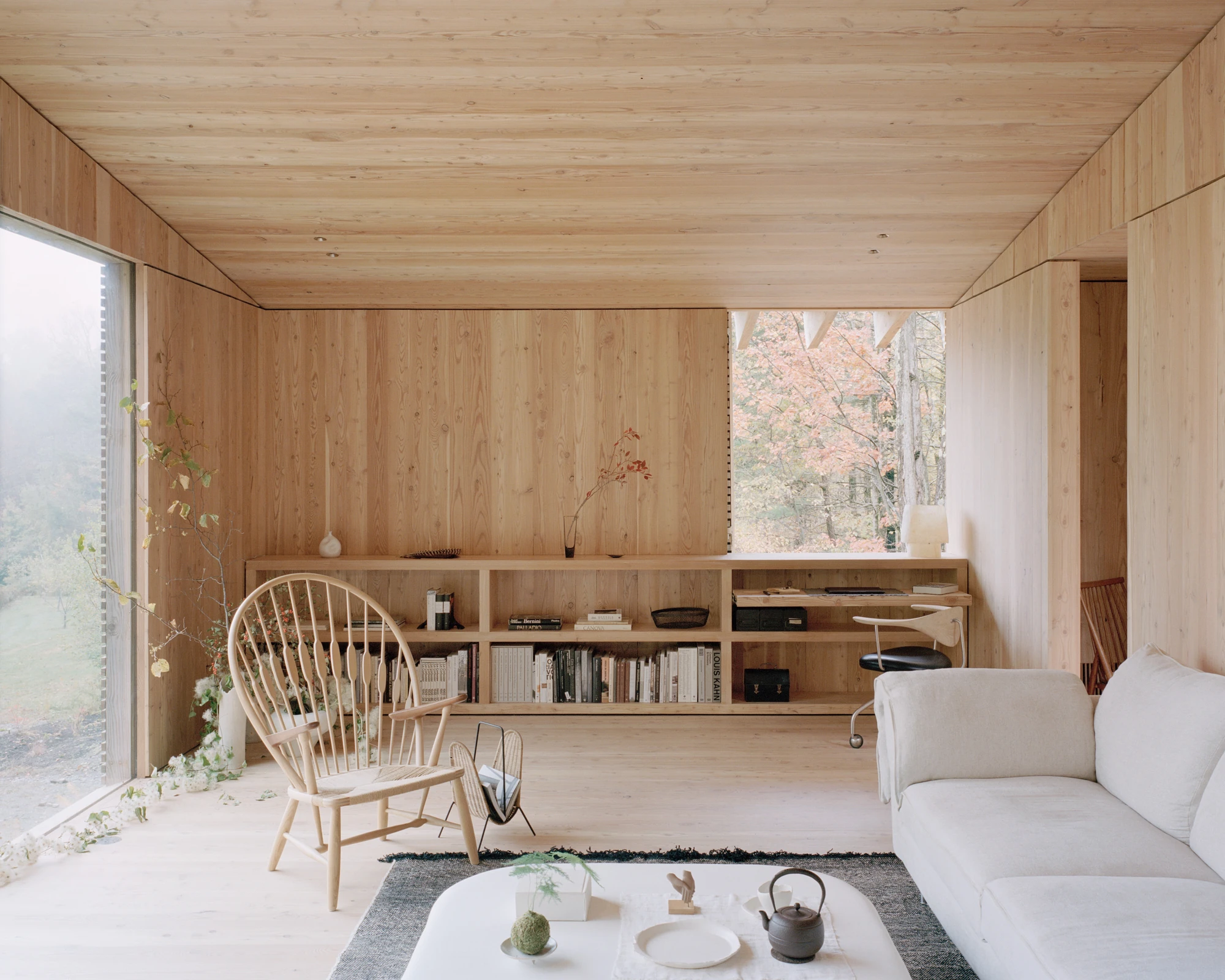
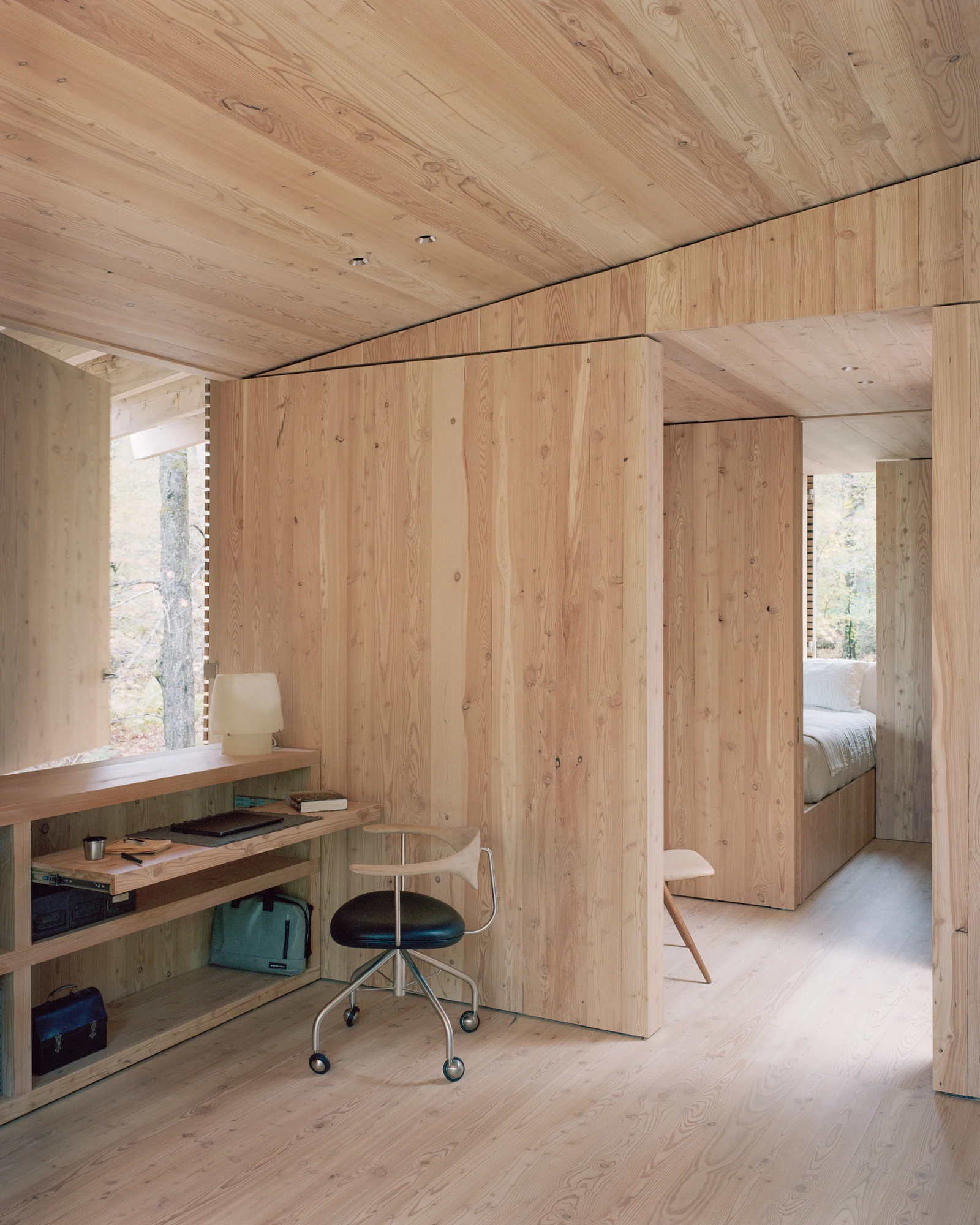
Inside, the plan is symmetrical but varied. Two bedrooms and a bath occupy the corners, each with a large fixed window and operable wooden shutters that recall a treehouse bunk. The central living and dining space opens out through floor-to-ceiling glass, producing a rhythm of compression and release borrowed from regional mountaineering lodges and backcountry cabins. Portions of the wall pivot open for ventilation, so opening a window becomes a physical gesture rather than a mechanical one.
Details inside are guided by restraint. The kitchen island is carved from a single block of Vermont Verde serpentine, quarried in Barre, Vermont, from the source that supplied the planters at Mies van der Rohe's Seagram Building. Its veining is left unpolished, reading like a fragment of hillside drifted indoors. Door and shutter hardware fabricated by Ize reinterprets Le Corbusier's La Tourette monastery handles, cast in stainless steel. The Findling sits as both dwelling and transformation, an effort to move perception, as the studio puts it, from the subliminal to the supraliminal.