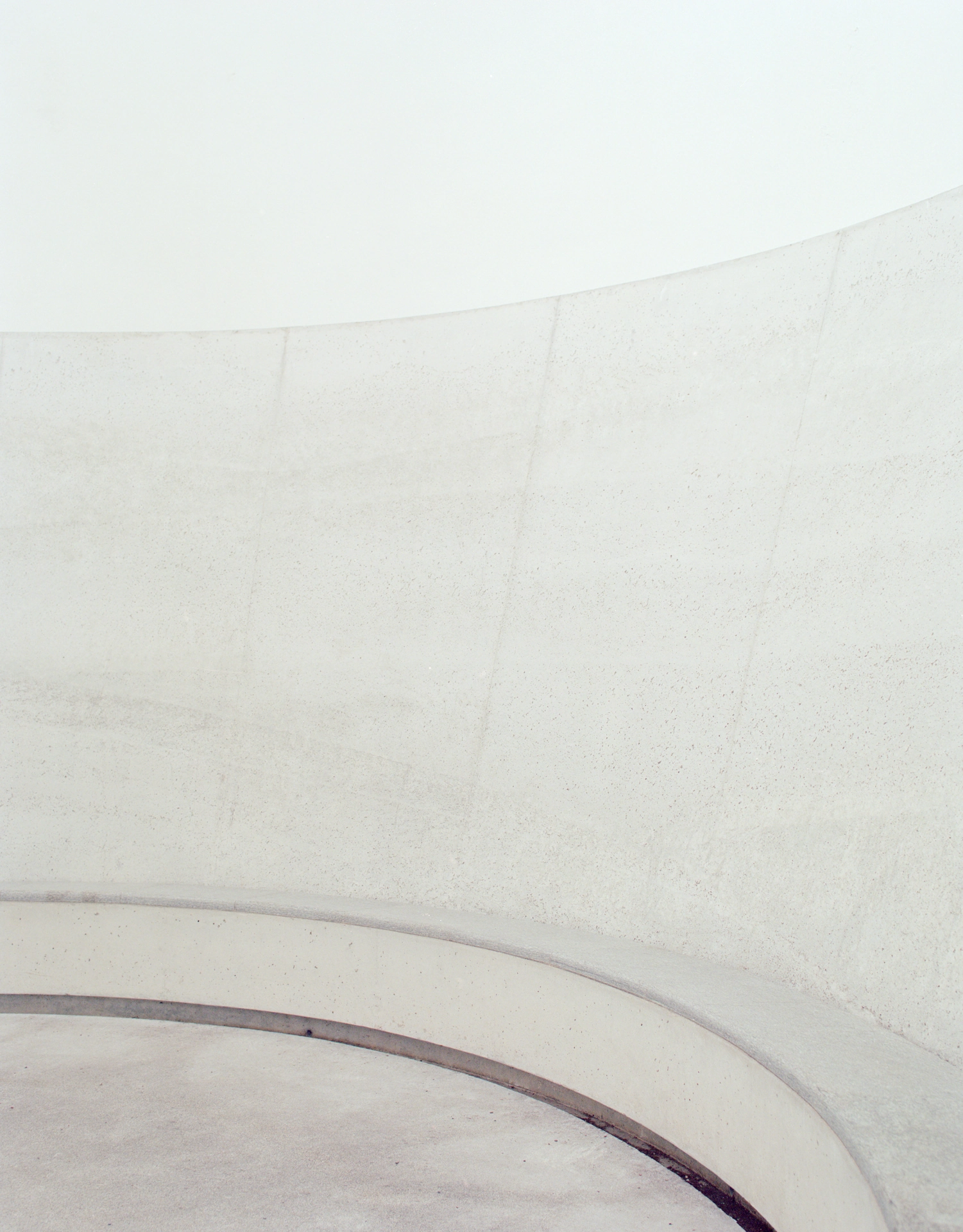
A single circular opening cut through the ceiling turns the sky into a changing field of colour inside Skyspace Piz Uter, the stone cylinder James Turrell set in a meadow above Zuoz in Switzerland.
Skyspace Piz Uter, completed in 2005, is a permanent installation by James Turrell, set in a meadow above the village of Zuoz on the grounds of Hotel Castell. It was commissioned by the Walter A. Bechtler Foundation and belongs to the public art programme art public Plaiv, which has placed works across the valley's villages. Built with OAP Architektur & Projekte, it reads first as a plain object: a cylinder in stone and concrete, standing alone in the grass.
A rubble-stone wall of granite wraps the drum, and an entrance opens in the wall. The wildflowers, grasses and distant mountains that surround it set the terms, so that the cylinder is both a part of this wider landscape and the point toward which it gathers.
Step through and the register changes. The inner walls belong to a concrete cylinder, curved and close, with a bench set along its base. There is almost nothing to look at, which is the point. The restrained geometry pulls attention up to a circular opening cut cleanly through the ceiling, 340 centimetres across, holding a disc of open sky. With nothing to measure it against, the boundary between the enclosed interior and the open sky begins to feel uncertain.
What the opening frames is never fixed. As daylight shifts, the sky changes in colour and appearance, and the relationship between the opening, the surrounding surfaces and the atmosphere is continually transformed. Coloured neon tubes under electronic control are part of the work, and the experience unfolds above all in the transitions between day and night. For Turrell, light is the material, held here as the medium through which space becomes perceptible rather than as the thing that lets other objects be seen.
The result asks for a slower kind of looking. Sit long enough and the shifts in brightness and colour begin to register as duration; the programme behind the work describes the sensory encounter widening into an awareness of time and of one's own existence. The project received a prize at the Velux Daylight Award in 2010. What stays is simpler than any accolade: a stone room in an alpine meadow, built around a hole in the ceiling, where the sky is handed back as something to watch.