VUILD inserts a narrow cedar tower into Nihonbashi-Kayabacho, Tokyo — a modular timber building assembled in two days on site, designed for disassembly, and conceived as construction that outlives any single urban plot.
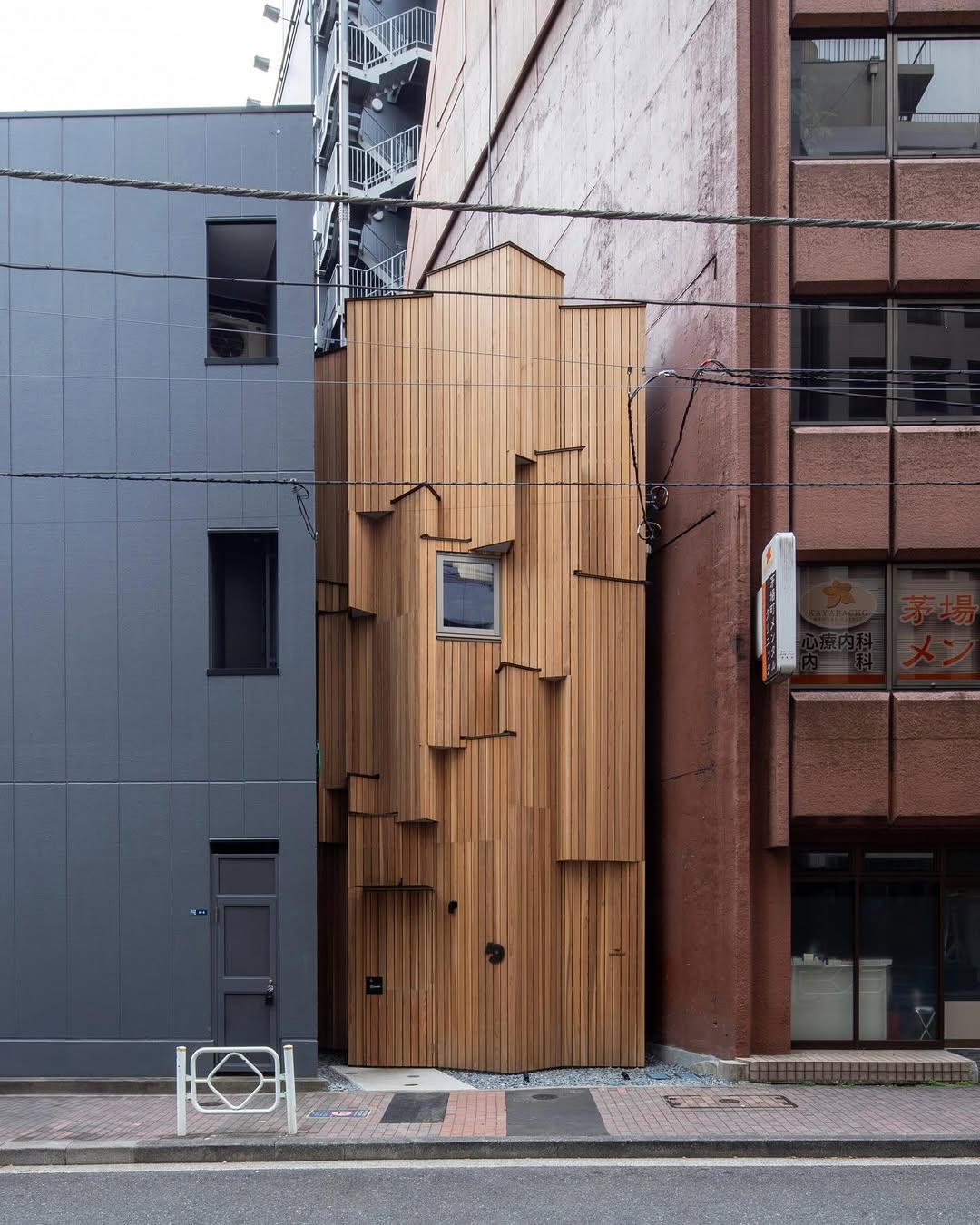
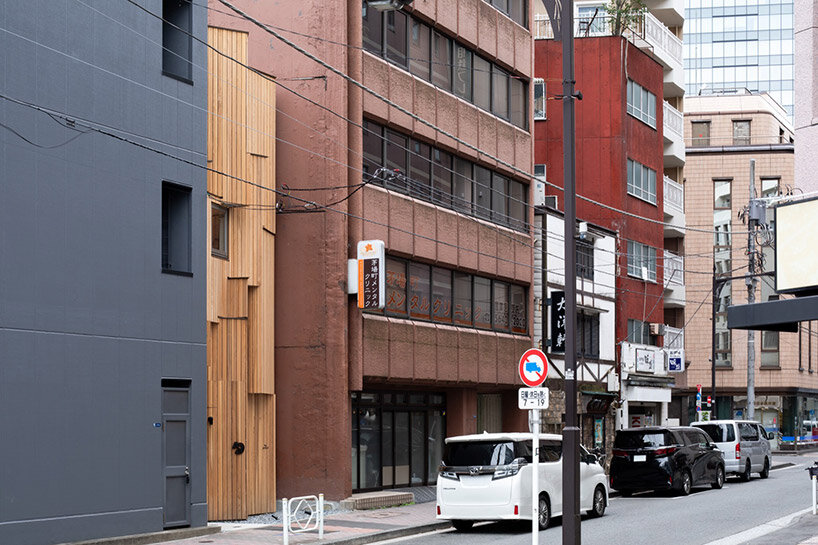
Prewood occupies a tight infill plot on a Nihonbashi-Kayabacho street in Chuo-ku, one of central Tokyo's most compressed urban grids. The site falls within a fire prevention district, a regulatory designation that normally constrains timber construction in the historic core. VUILD's response was to develop their own cedar module system with cross-laminated timber ceilings rated for fire performance, slipping wood construction into a context that ordinarily excludes it.
The exterior is a vertical cedar elevation in untreated board-on-board cladding, but the surface is not flat. Staggered module joints produce a subtle stepped relief at the facade — angled cuts at the panel edges break the rhythm of the vertical boards, and shallow projecting shelves appear at two levels where the module stack registers against the neighbouring concrete party wall. The cedar will weather without coatings, shifting tone with Tokyo's climate across the building's first life. A single small window opens on the street elevation; entrance is through a flush cedar door set directly into the cladding.
The primary structure was erected in two days on site, a direct consequence of how far VUILD pushed the fabrication process upstream. Digital models defined the position of every screw; that data drove CNC cutting directly, with no manual translation step. On site, 3D-printed alignment guides held each joint during assembly, allowing standard labour to achieve tolerances that would otherwise require specialist timber carpenters. Scaffolding space was limited on the narrow plot, which forced everything precise into the pre-made parts.
The interior is organised as a split-level section: service spaces and kitchen toward the street side, a gathering zone in the deeper footprint at each level, and a rooftop terrace at the top. Ceilings are exposed cedar board-and-batten; walls are plaster. The staircase runs along the inner face of the building, each landing offering a change in ceiling height that makes the narrow footprint read longer than it is. A ground-floor dining room with stone-topped tables and red-lacquered base rails sits under the sloping cedar ceiling, scale held by the constraint of the site rather than expanded against it.
VUILD frames the project as a three-part lifecycle proposition: disassembly, relocation, and reuse. The modules are designed to be taken apart and reassembled on a different site after their current tenure ends, with every connection screwed rather than glued. The studio positions prewood as a working example of small-scale timber construction adapted to dense urban conditions — not a prototype, but a building already doing what it proposes.