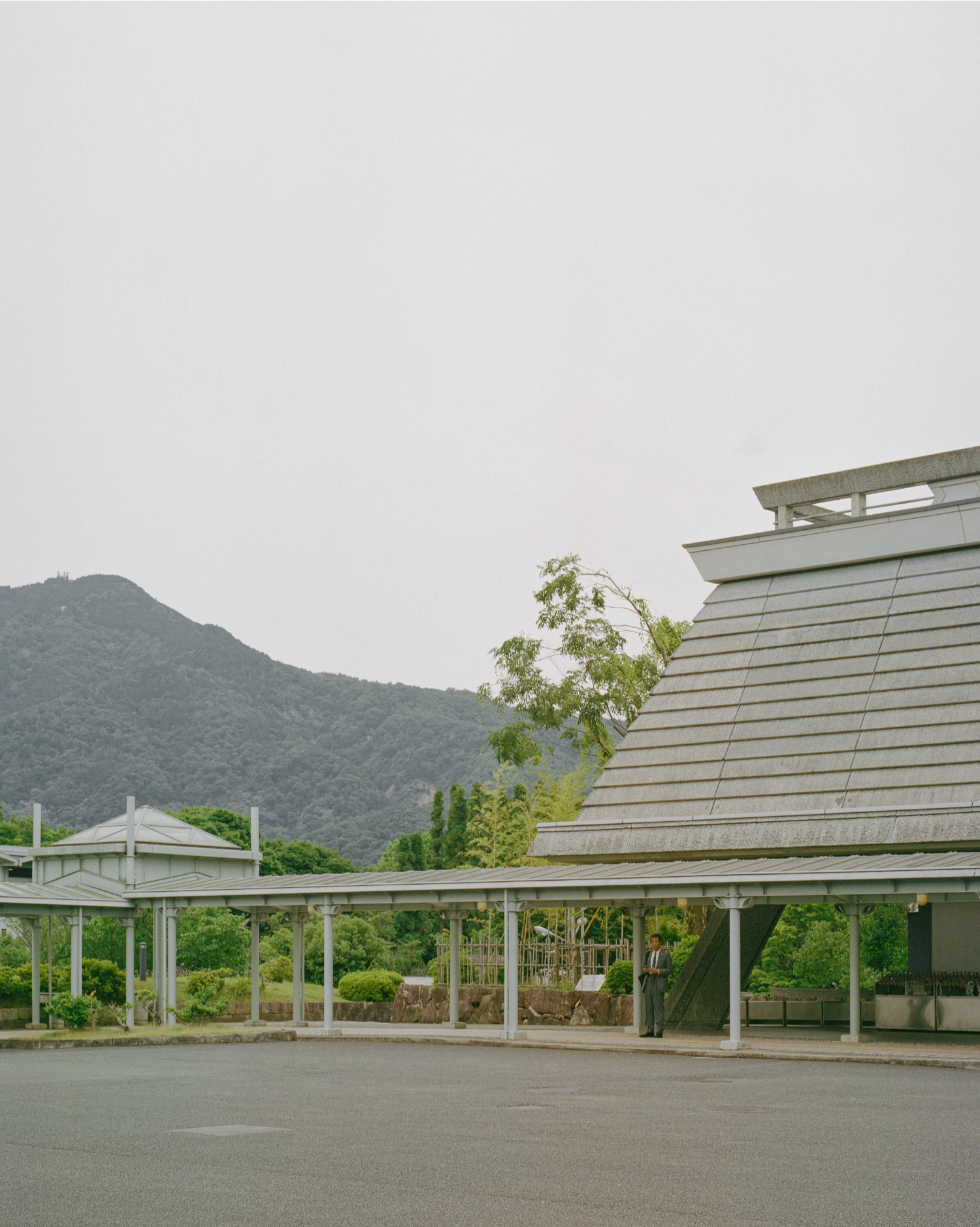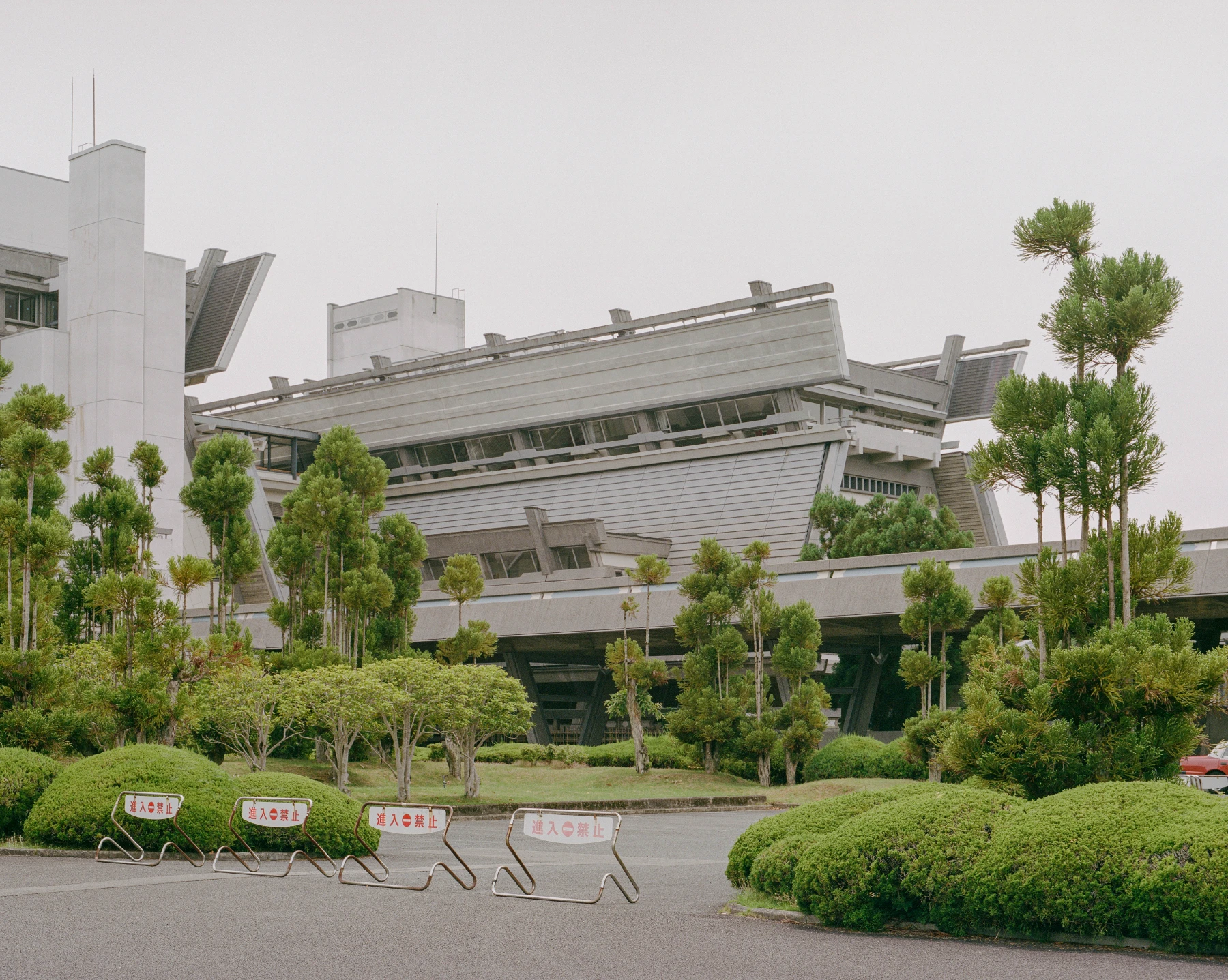
On analogue film, Brook James turns Sachio Otani’s Kyoto International Conference Center into a study of weight, rhythm, and quiet tension.
His images reveal how a building often described in grand geopolitical terms can also be encountered as a sequence of intimate, shifting geometries.
Approached through James’s lens, the complex abandons its reputation as a monumental outlier on Kyoto’s northern edge and becomes instead a choreography of inclined columns, compressed planes, and sudden expansions of space. Otani’s trapezoidal grid, famously driven by columns pitched at 22 degrees, reads less like an engineering flourish and more like a deliberate destabilisation of modernist certainty. In James’s photographs, this geometry feels in motion, even when the structure sits perfectly still.
The influences that shaped the project—shrine carpentry, gassho farmhouses, even the character for person or enter—surface not as literal quotations but as atmospheric echoes. Otani’s concrete carries the grain of those references without imitating them, producing a sense of shelter that is simultaneously archaic and futuristic. James’s analogue process heightens this tension; the soft granularity of film makes the structure feel more rooted in its landscape, even as its angles suggest a vessel newly arrived.
What emerges is a portrait of modernism that is neither internationalist nor strictly local but suspended between the two, much like Japan’s own ambitions when the building was commissioned. The Conference Center may never have achieved the diplomatic stature imagined in the 1960s, yet through James’s study its presence becomes newly resonant—an architecture of communication, scaled from the monumental to the personal.