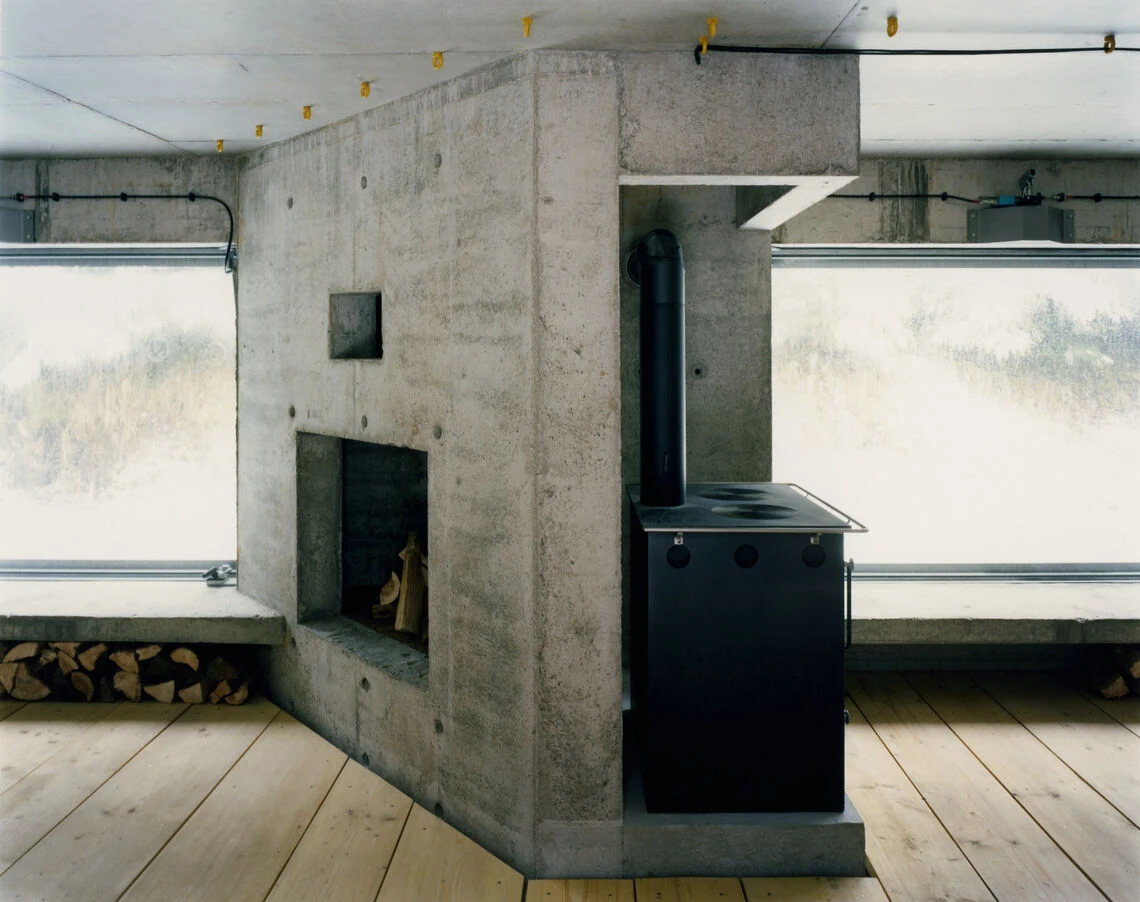
On the road between Rittersgrün and Oberwiesenthal, in the Ore Mountains of Saxony, Germany, AFF Architekten's Hutznhaisl appears like something wrestled from the landscape itself—a concrete sculpture at the edge where "the border between civilisation and nature is where trees begin to outnumber houses."
The project started with a deceptively large question about how far modern life has drifted from elemental experience. The architects observe that fire has essentially died out of our homes—"its unwitting last keepers were the smokers; all other sources had already been largely electrified." Water "comes from supermarkets in the form of an almost infinite variety of bottled mineral water, or flows from the wall like an afterthought." Darkness has been eliminated. We control light and heat with technological helpers the way we control everything else. The Hutznhaisl asks: what happens when all of that is gone?
Here, on Fichtelberg Mountain, there are no mobile phone signals, no dishwashers, no televisions, no condensing heaters. The mountain hut accommodates six to eight people and offers food, and the quality of its details "is derived solely from tangible things." Walls and ceilings are formed in concrete. Wooden floorboards come from locally cut spruce. Fittings—switches, lights, chairs, wash basins—are recycled. Stoves are steel. Windows are generous. Everything about it is, as the architects put it, "unostentatious and sparse from a technical, functional and aesthetic point of view." And that is precisely the point.
The hut opens only to the forest, "like a bus stop opens only to the street, always in the direction of the intended destination." Far from snowboard slopes and leisure spas, the space distances itself from the dynamics of modern life. Any hiker can confirm what the architects seem to understand intuitively: "an impressive peak, fresh air and a tasty snack are all they need for an elemental experience, just like Hans in the Grimms' fairytale Hans in Luck, to whom freedom was more important than possessions and wealth."
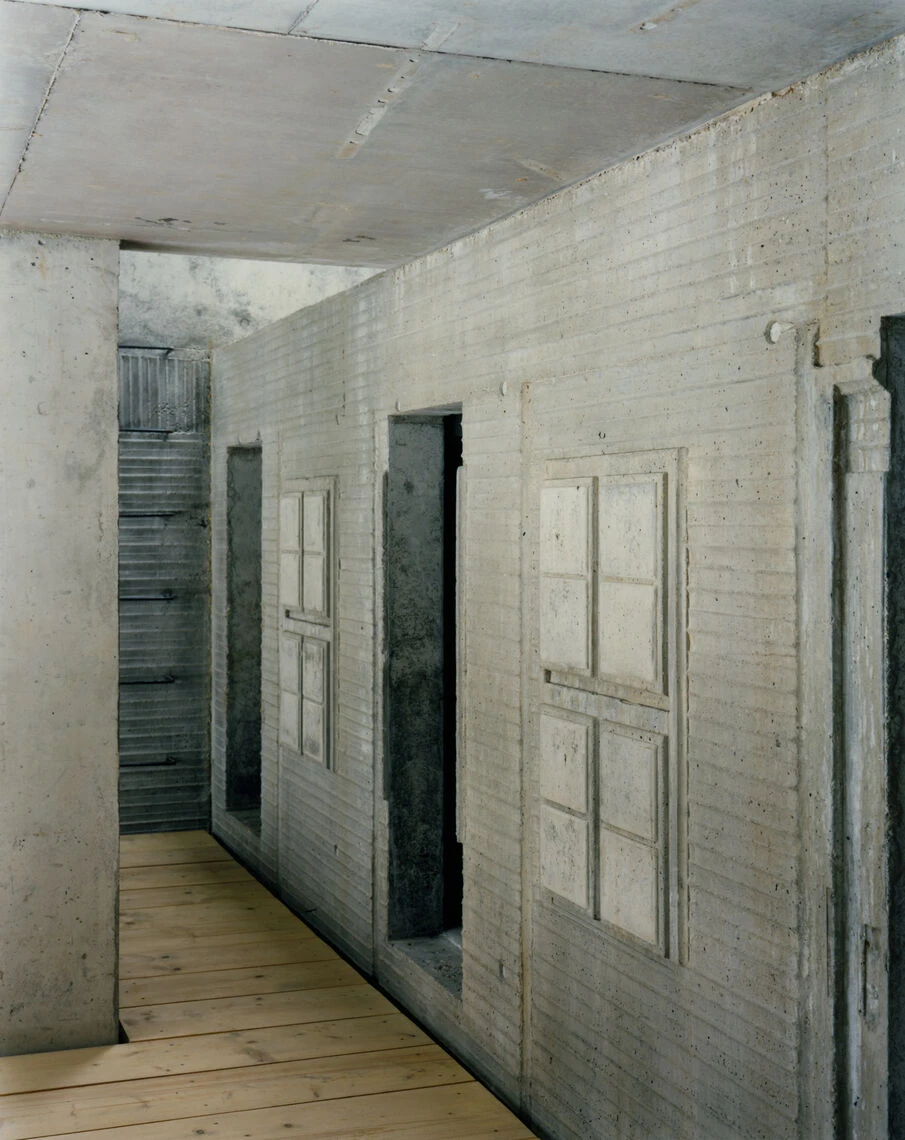
Inside, the Hutznhaisl preserves something of what came before. The original structure—a type bungalow built as a weekend home, later repurposed as locker rooms by the Dynamo sports club—was abandoned to its own fate, but its form survives as a relief-like imprint in the new concrete. "The act of decoding and discovering the relief-like markings of the form and surface of the former wooden hut," the architects write, "is reminiscent of a hunter following tracks in the forest." The old building offered its shape as a mould, and the new one carries that memory forward like a lantern slide projected into the present.
The hut's silhouette is neither nostalgically traditional nor striving to be avant-garde. It is, instead, "a courageous re-interpretation of the typology of a traditional hut"—one that does not pretend to be timeless but earns its place by being honest about what a shelter can be. It is the kind of architecture that has the quiet power to draw city people to a remote village "with more carved wooden Christmas decorations than residents." That says something about what people are hungry for, even if they cannot always name it.