In the oak woodland of Vilches, Chile, Smiljan Radić builds a black concrete house derived from one of Le Corbusier's abstract lithographs — three rooflights at odd angles, a cantilevered bedroom, and a garden of 300 basalt stones.
The starting point is a painting. Le Corbusier's series "The Poem of the Right Angle" comprises a sequence of abstract lithographs in which figurative and geometric elements coexist in ways that resist resolution. Radić chose one panel from the series — "Flesh" — in which a woman kneels, a man's feet are visible, a menhir appears, and a hand marks the sky. The Chilean architect's reading of this image is characteristically direct, and characteristically oblique: "The observer occupies the body of a man stretched out in an ambiguous setting. He seems to be looking at an inner landscape in which a woman is kneeling, leaning towards an opening that shows a cloud passing." This is the house that follows from that observation.
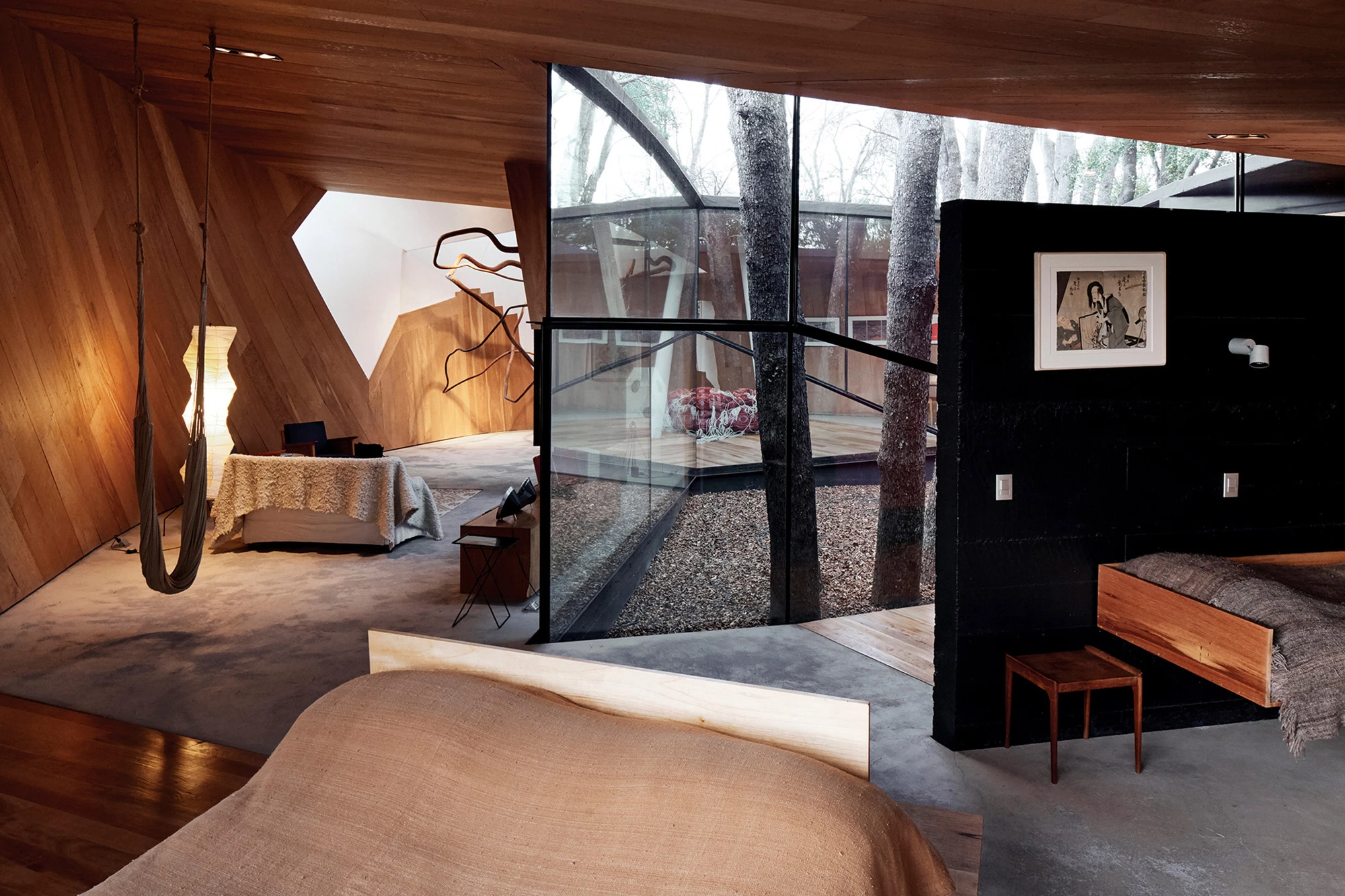
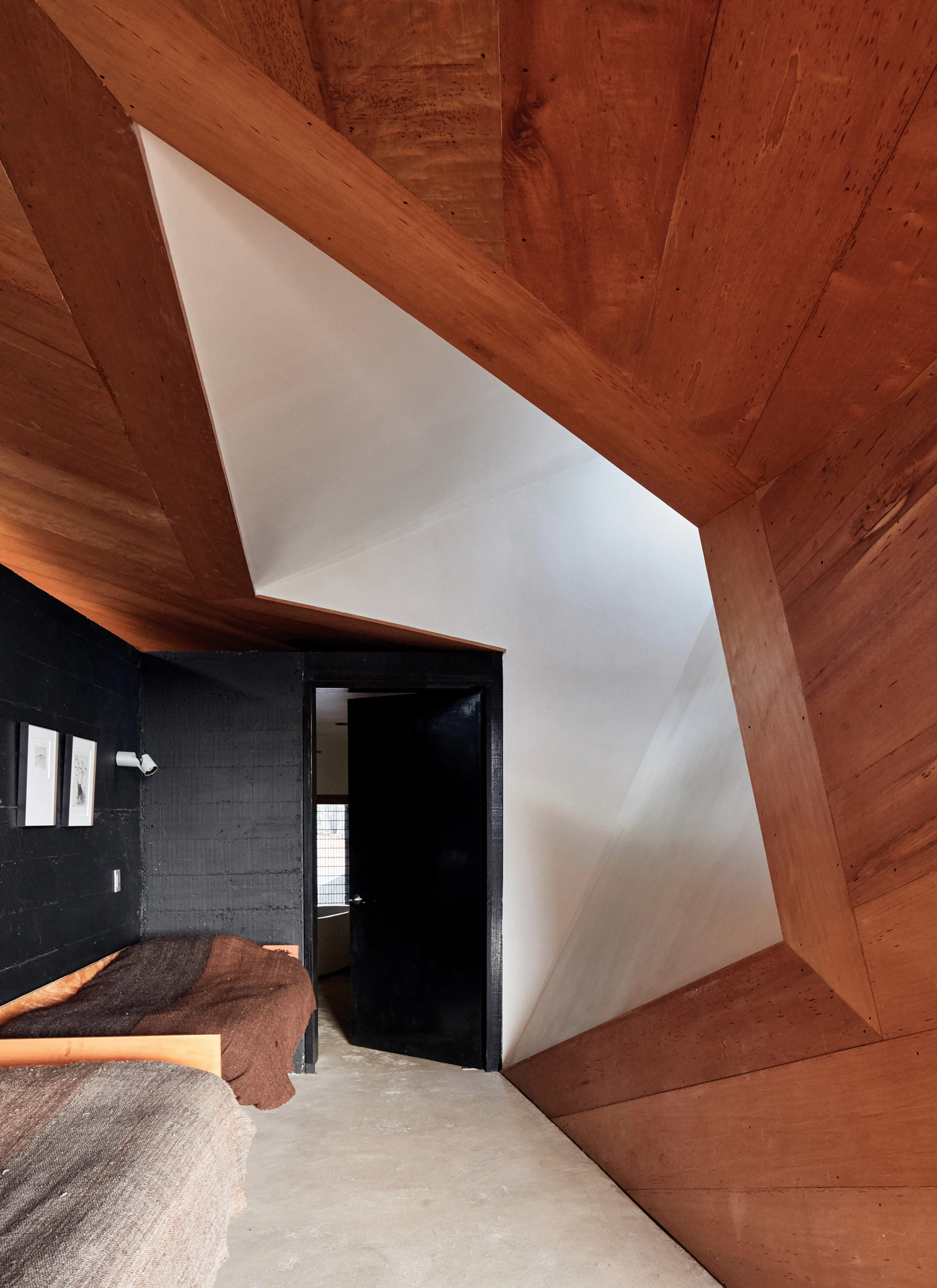
The building is formed from twelve-centimetre-thick reinforced concrete walls painted black — a mass that reads, from the forest floor, as a volume of compressed darkness among the pale trunks of the oaks. Three rooflights extend at the irregular angles dictated by the painting's geometry, creating lightwells that punctuate the plan and pull zenithal light deep into the interior. The plan itself is a continuous walkway around a central courtyard, with glazed walls facing inward to offer views across the patio to other areas of the residence. The movement through the house is circular, centripetal.
Inside, the black exterior inverts completely. The walls and ceilings are lined in warm cedar, the lightwells painted white and faceted into faceted monumental volumes. The shift is total: from mineral to vegetal, from compression to warmth. The materials further define the program in lieu of dividing walls — wood flooring in living areas, concrete in others, a suspended wood-covered chimney hovering in the living room. "Its seclusion accounts for how its inhabitants know the surroundings," Radić has said, "as a peasant, a vagrant, or a monk would know them, naturally."
The cantilevered master bedroom terminates in a huge window overlooking the forest — a frame for the mountain landscape that is also a physical extension toward it, hovering above the hillside. The garden, designed by Marcela Correa, is anchored by the Garden of Leaves: 300 basalt stones arranged around the perimeter of a swimming pool that faces the mountains. "It is a blind volume in front of a privileged mountain landscape," Radić writes, "encrusted in a wood of oak trees." The description of blindness is important — the house gives nothing away from outside. Everything it knows, it keeps within.