Thisispaper Community
Join today.
Enter your email address to receive the latest news on emerging art, design, lifestyle and tech from Thisispaper, delivered straight to your inbox.
Oops! Something went wrong while submitting the form.
Instant access to new channels
The top stories curated daily
Weekly roundups of what's important
Original features and deep dives
Exclusive community features
Thisispaper+ Member

Historical Oberamteistraße Museum by wulf architekten

Dates:
✧ Collect Post
Germany Guide
under the patronage of
Historical Oberamteistraße Museum by wulf architekten
Alexander Zaxarov
May 15, 2026

wulf architekten fills a gap in a 13th-century Reutlingen streetscape with a timber truss behind cast-glass tiles, bracing the historic row while making the demolished house partly visible again.

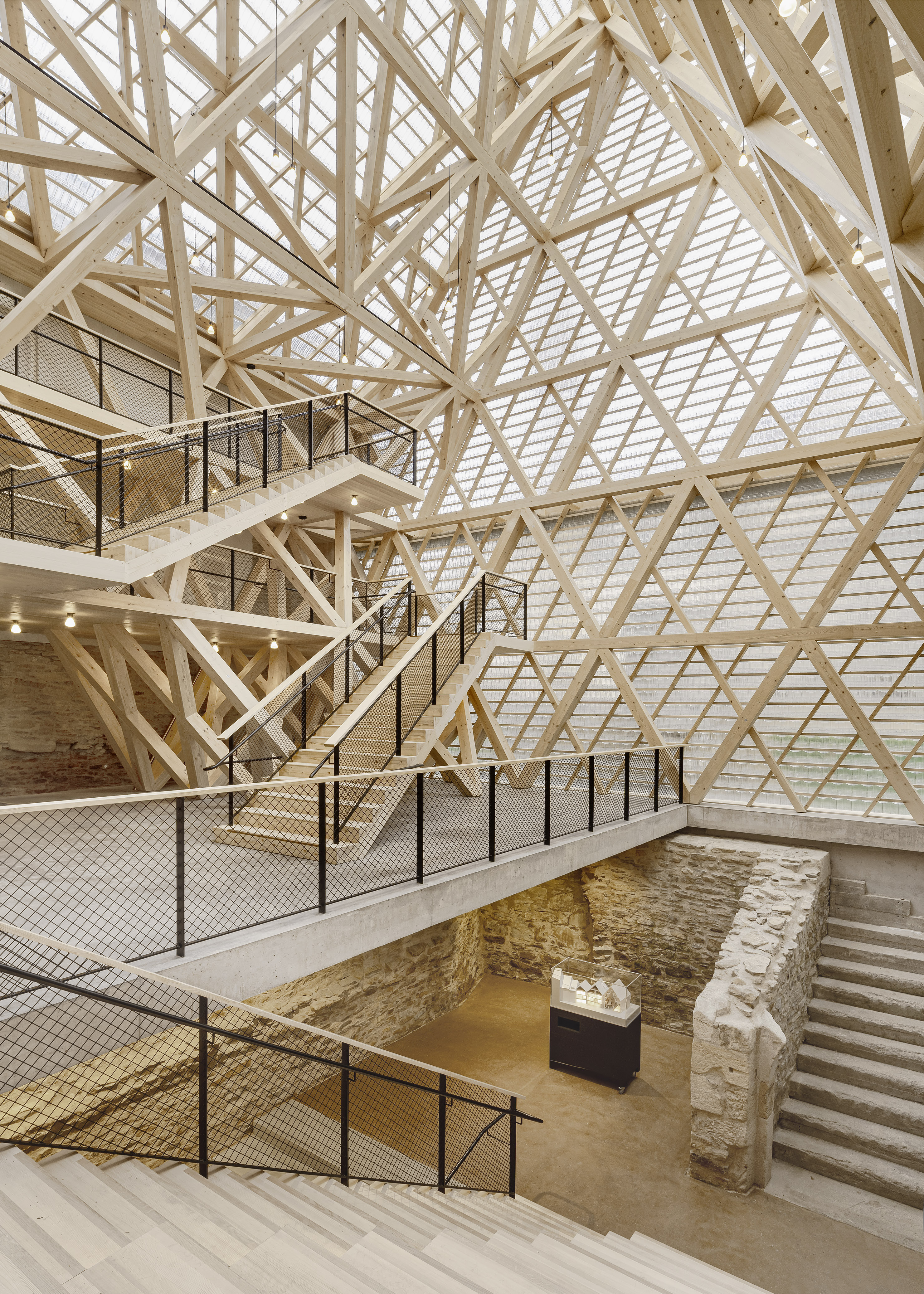
The site on Oberamteistraße holds one of the oldest rows of half-timbered houses in southern Germany, a sequence dating to the 13th century when Reutlingen operated as a free imperial city. Plot no. 34 was missing: its Stone House had been demolished in 1972, and only the cellar survived. The brief asked for two things at once: rehabilitate the historic buildings at nos. 28–32 under heritage criteria, and rebuild the corner as a protective enclosure for what remained underground.

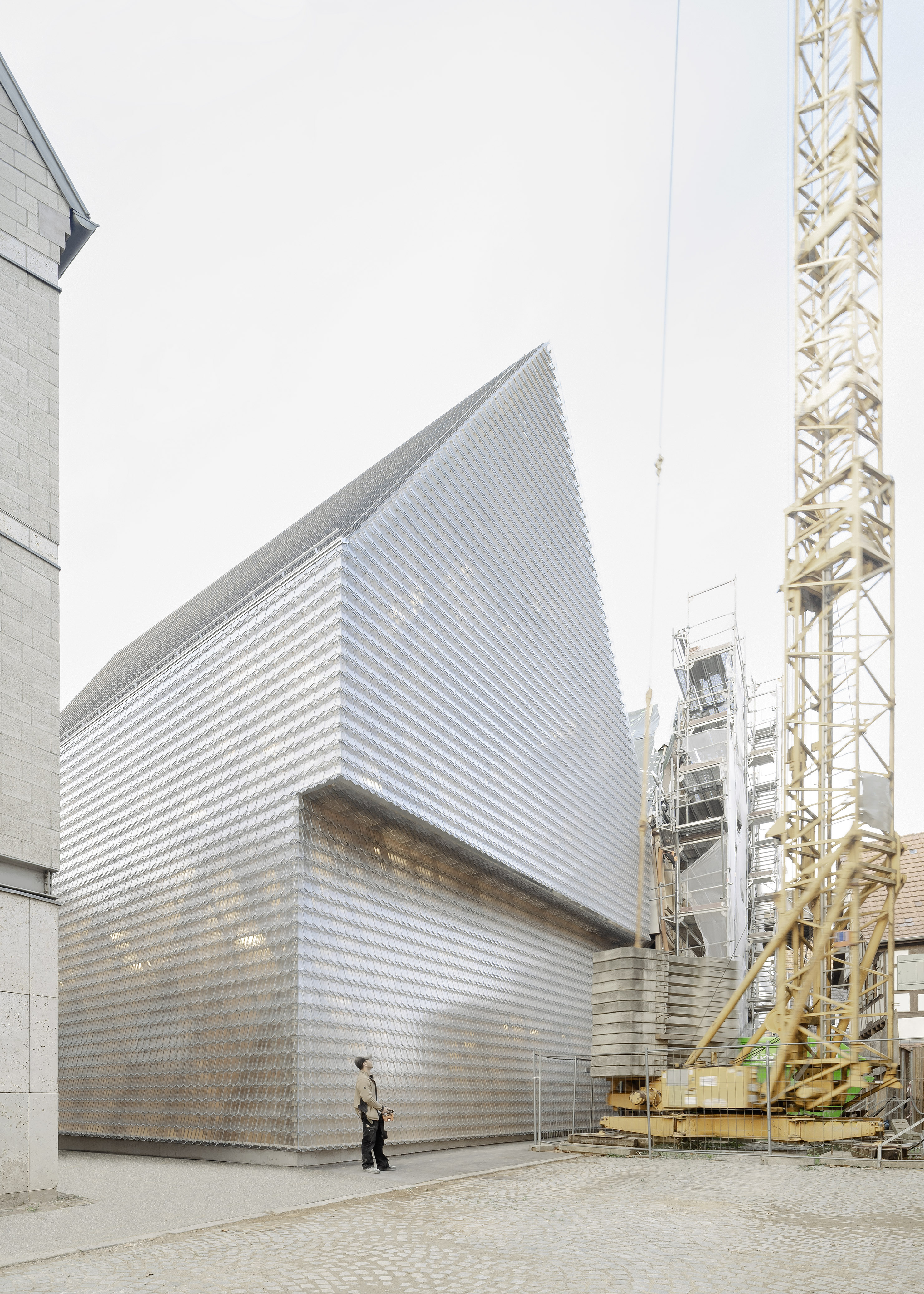
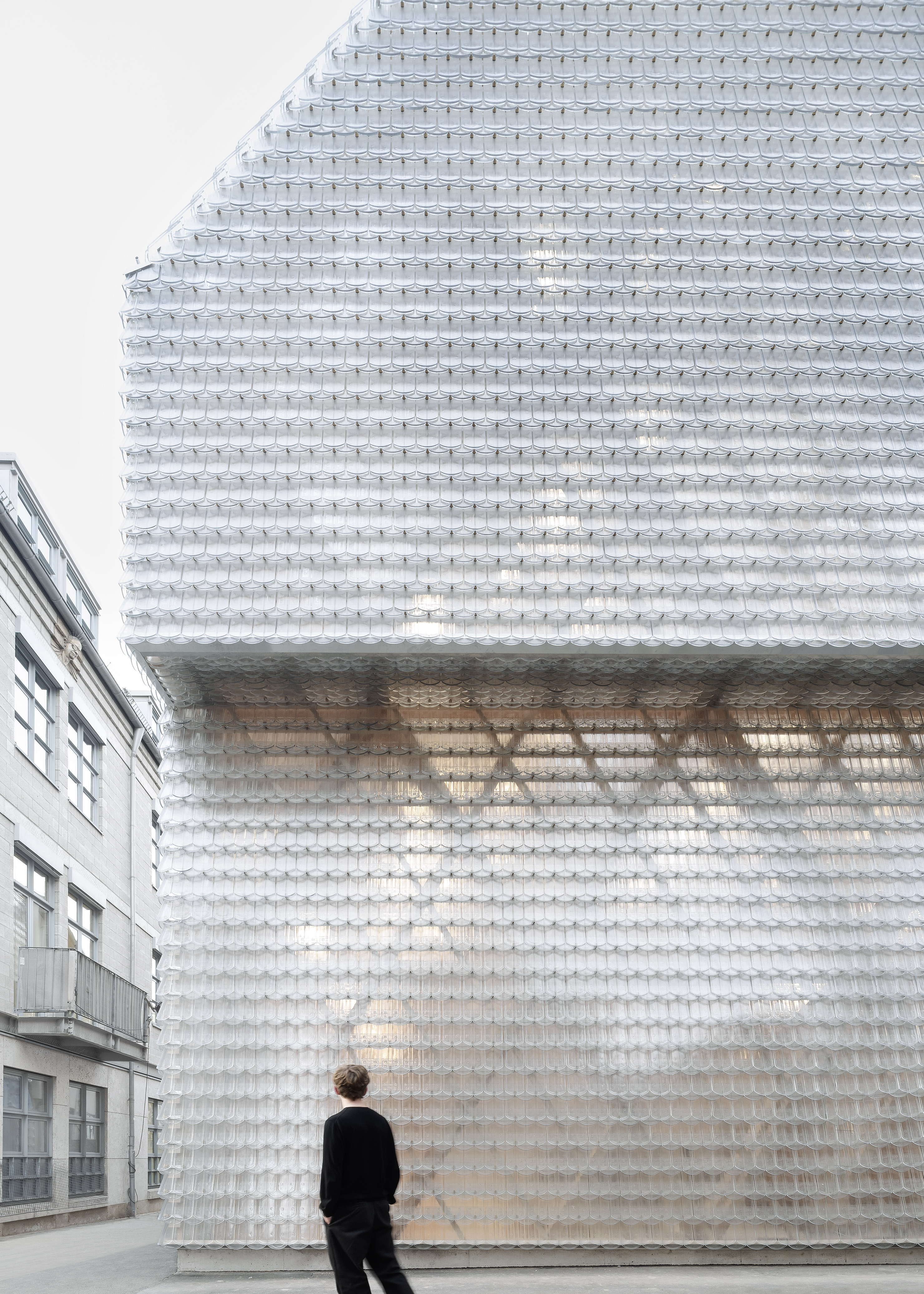
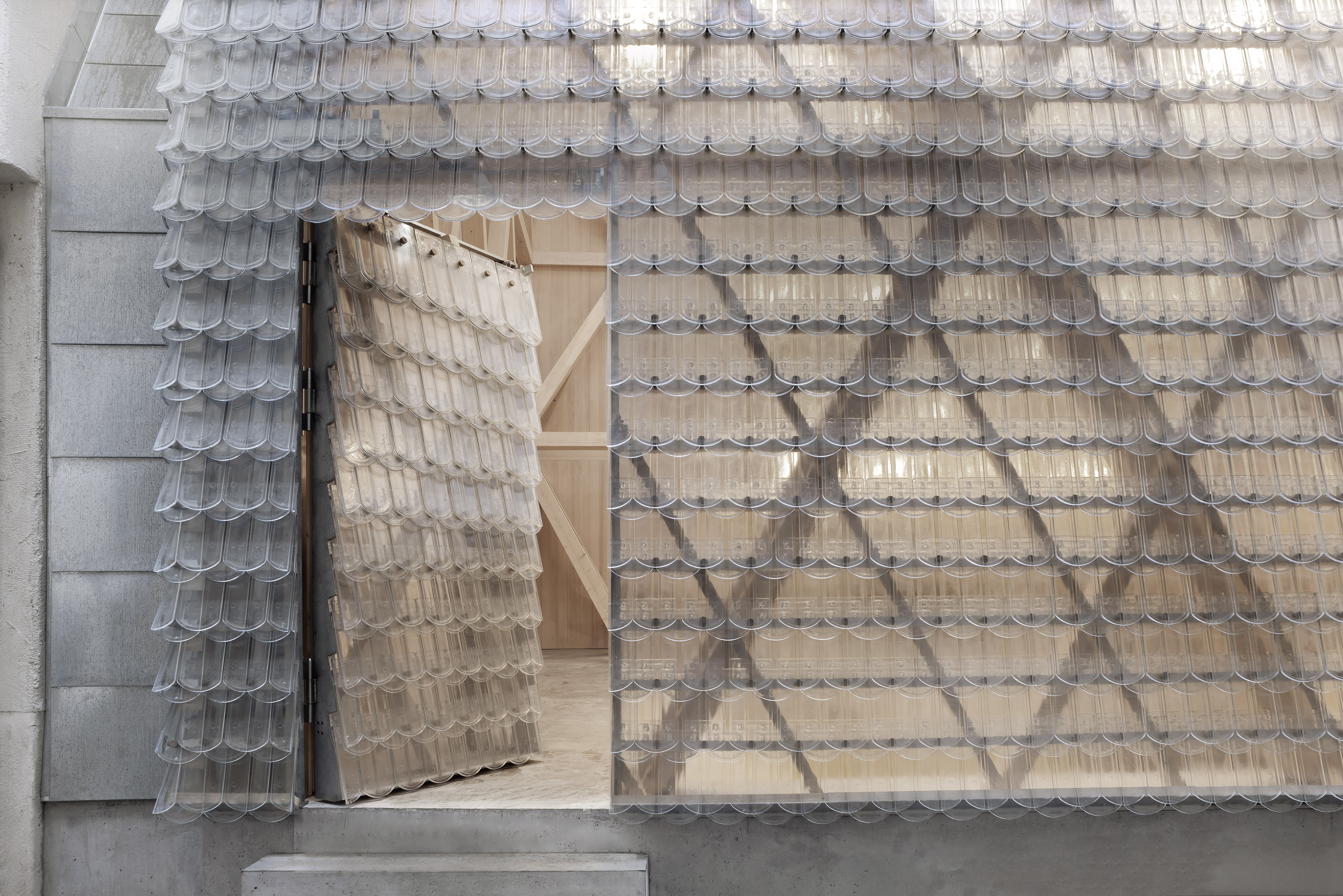
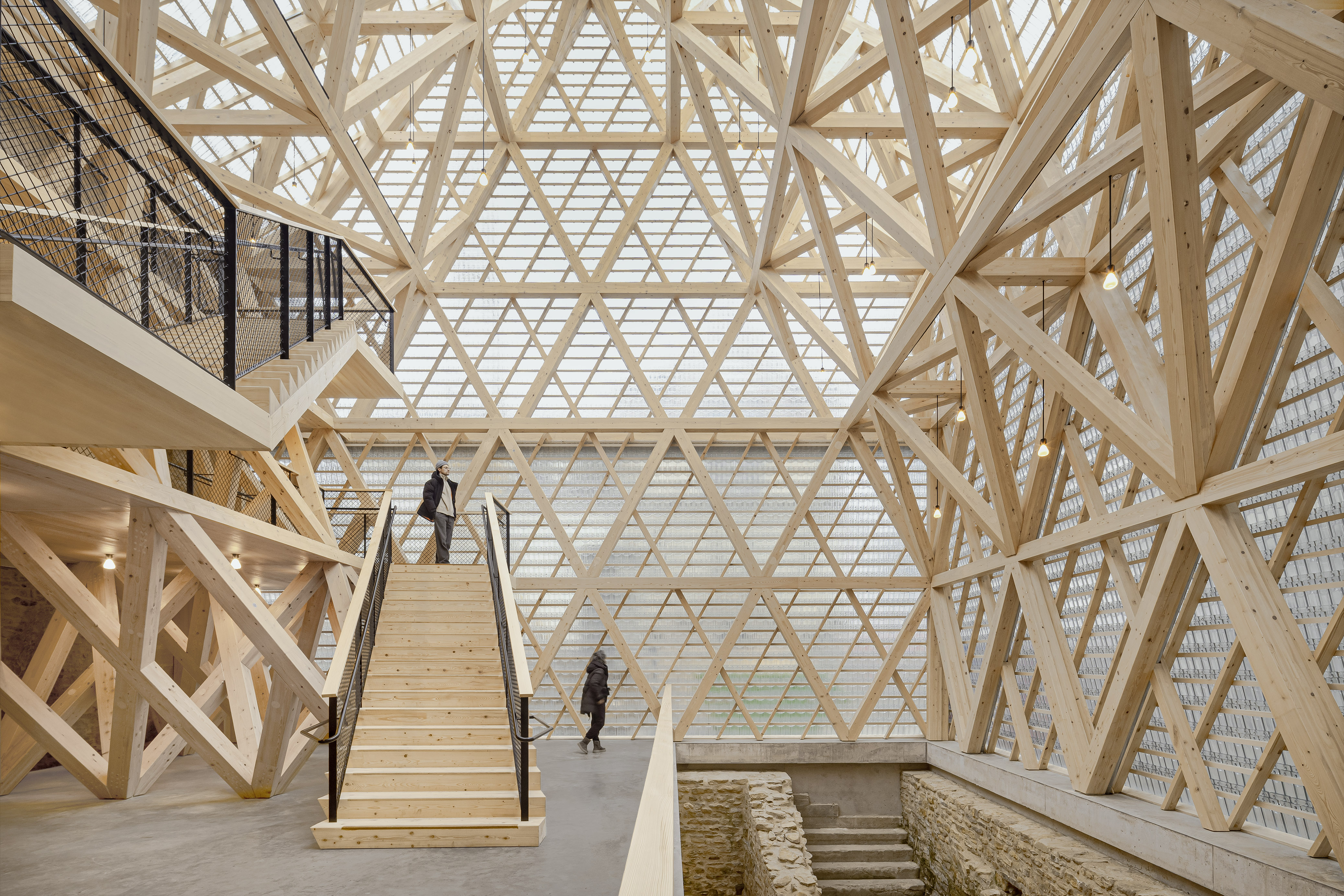
The new building is sheathed entirely in cast-glass beaver-tail tiles — the same rounded-bottom form as the clay Biberschwanz tile used on the surrounding roofs, translated into glass. The volume reads as a single iridescent surface whose tone shifts between silver-grey and warm amber depending on light angle and time of day. The wooden truss structure behind the tiles shows through at varying levels of clarity, more visible under direct backlight, half-dissolved in overcast conditions. The studio describes this as chimera-like: a building that blurs the boundary between interior structure and exterior cladding, like a distant memory of the house that stood there. "Something that persists in the memories of those who still knew the old house is made visible again for future generations."

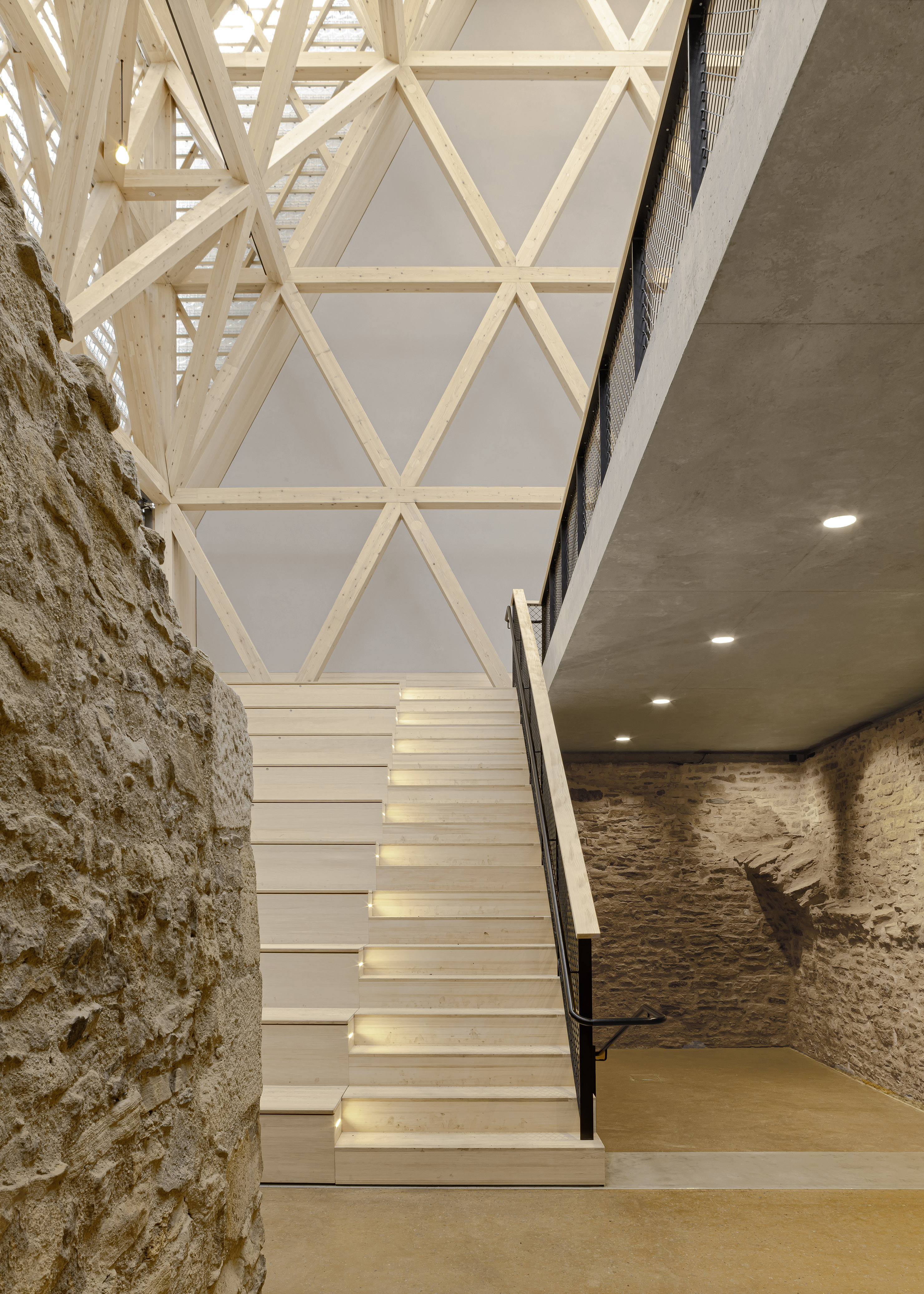
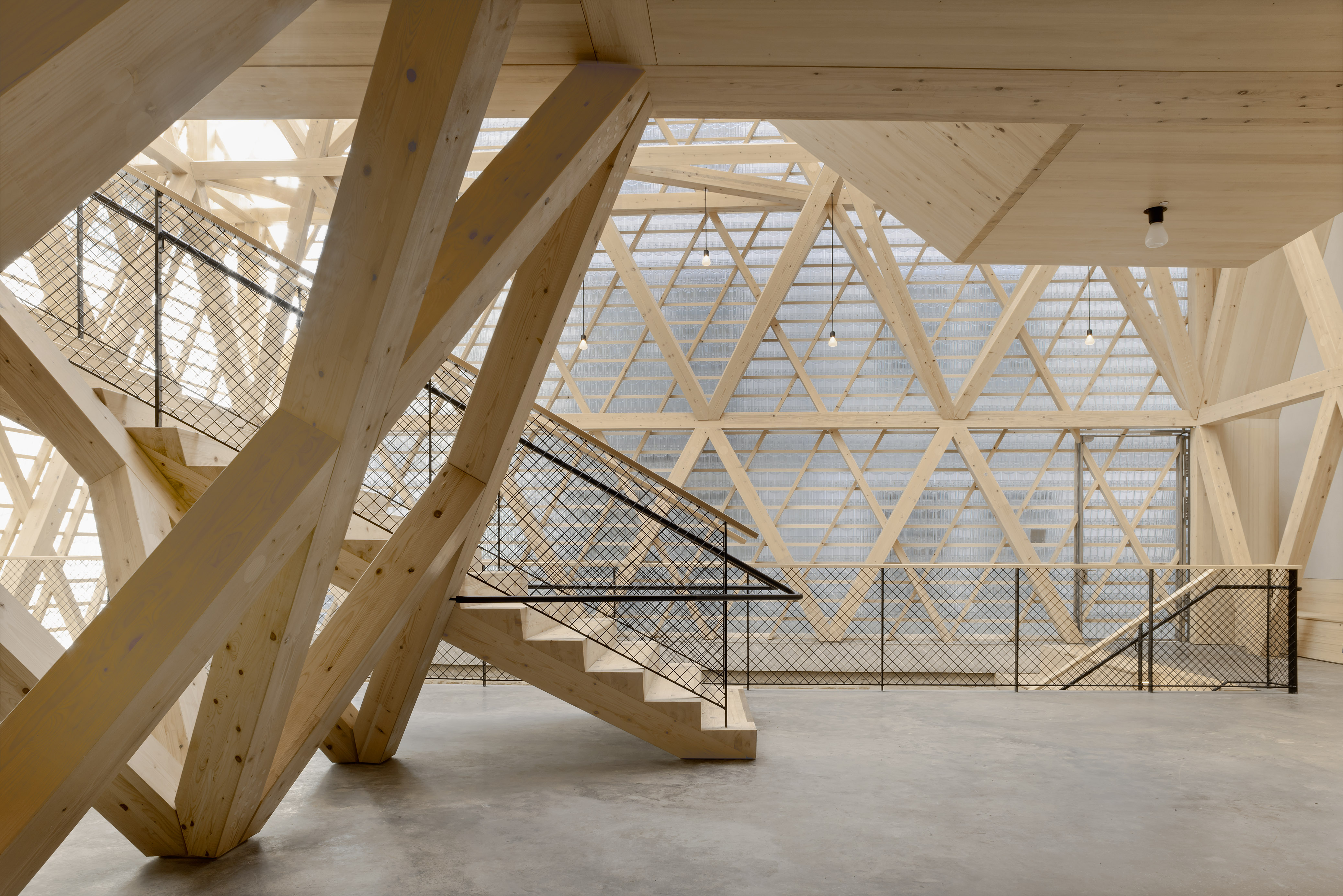
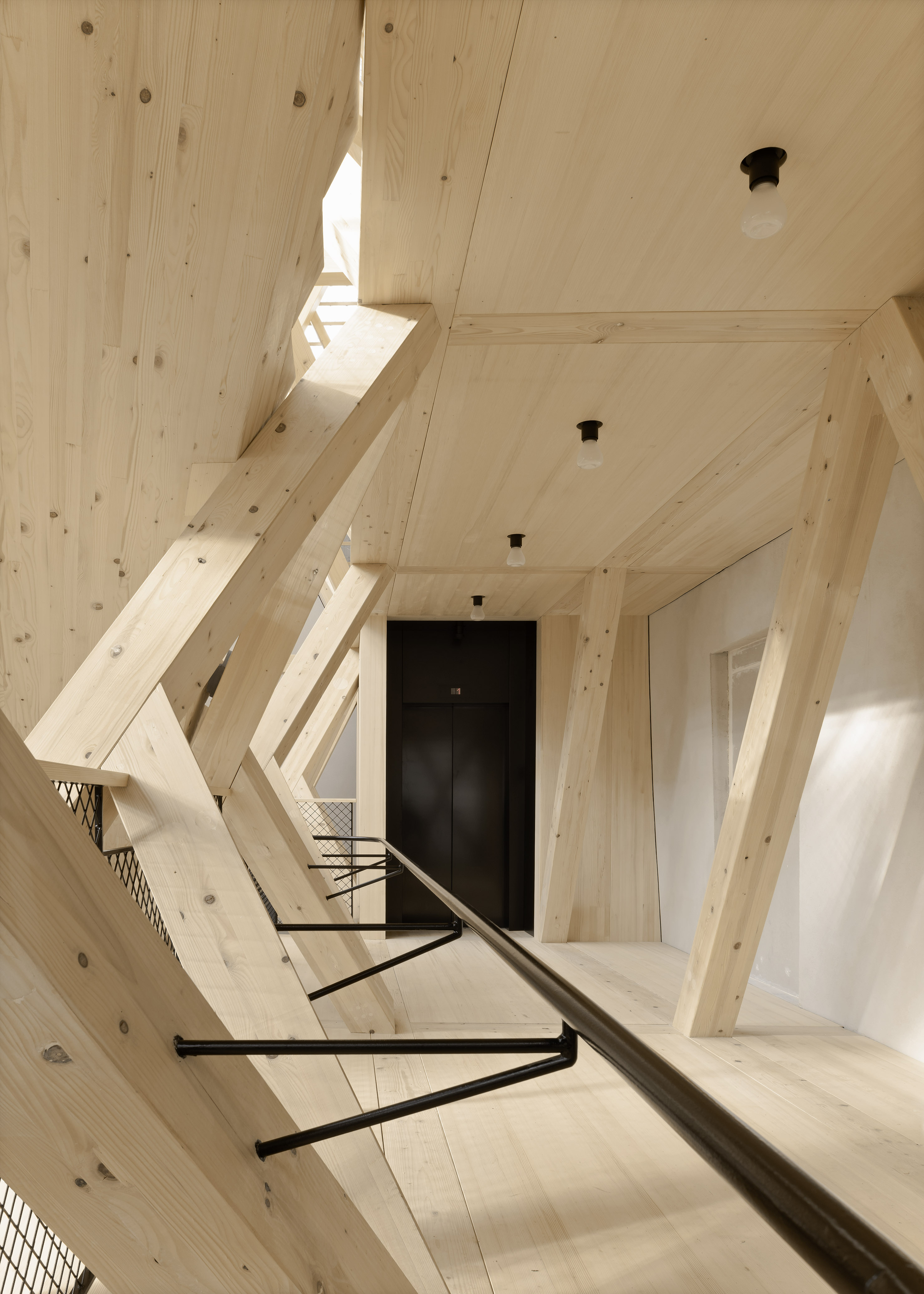
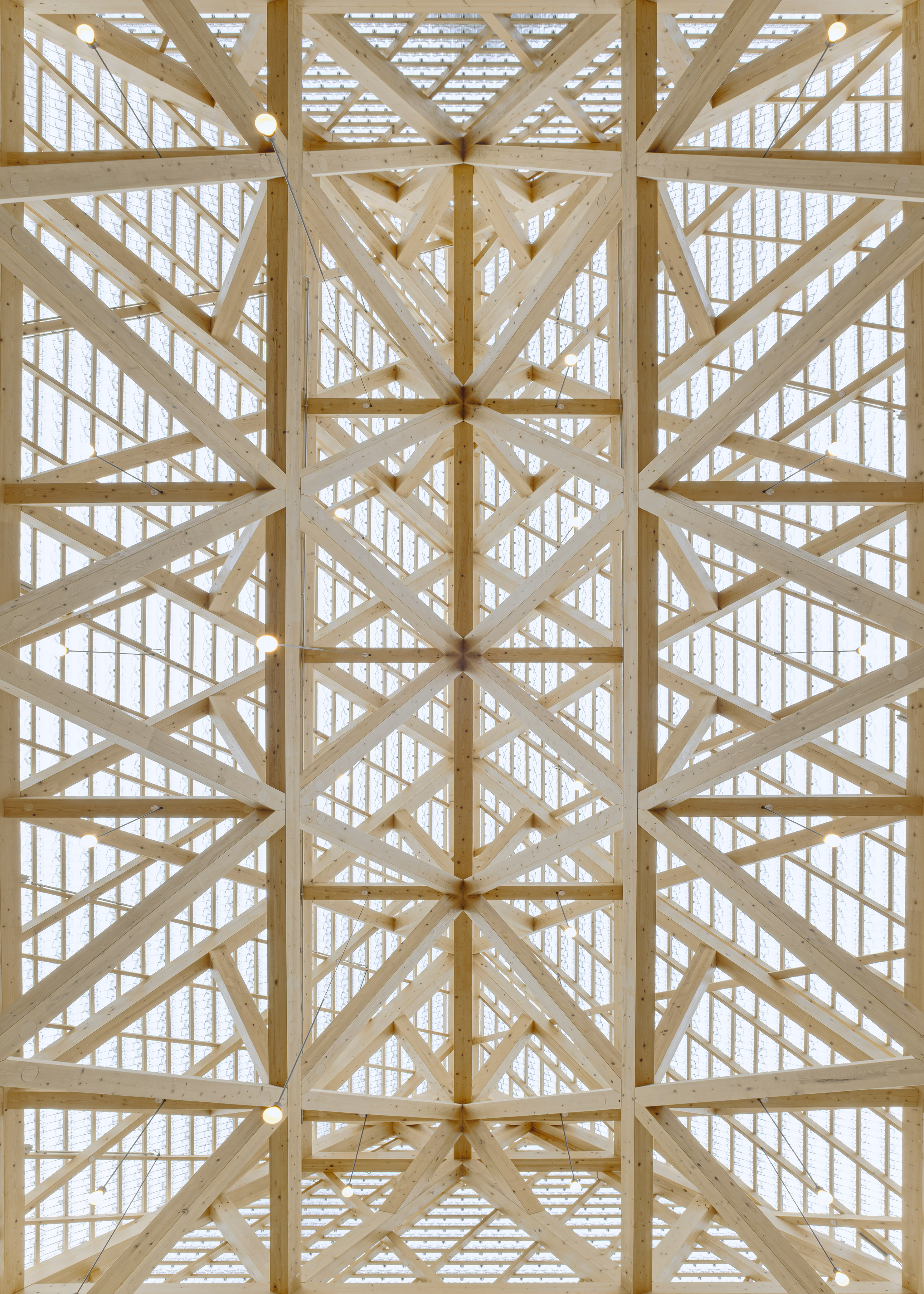
Inside, the parametric timber truss is the space. Diagonally overlapping spruce members in a triple-layer arrangement carry the glass-tile weather skin on the outside and define the main hall on the inside, where a full-height staircase connects the preserved medieval cellar to the upper event level. The geometry was computationally resolved: load paths and form developed together, with the truss simultaneously reconstituting the approximate volume of the demolished house and providing structural bracing for the adjacent buildings.

Sustainability is embedded in the construction method. There is no thermal insulation and no air conditioning; open joints between the tiles provide natural ventilation and smoke extraction. Every timber connection is screwed rather than glued or welded, meaning the building can in principle be disassembled and its materials returned to a production cycle. Concrete was avoided except where structurally required. The project received support from Germany's federal Nationale Projekte des Städtebaus program.

At 338 sqm, the building reads on the street as a calm, continuous skin — no contrast gestures, no legible entrance, just a surface that holds its ground without competing. At dusk, when the interior is lit from within, the wooden truss becomes clearly visible through the glass, and the new structure and the 700-year-old masonry behind it are readable as layers inside the same wall.
Interested in Showcasing Your Work?

If you would like to feature your works on Thisispaper, please visit our Submission page and sign up to Thisispaper+ to submit your work. Once your submission is approved, your work will be showcased to our global audience of 2 million art, architecture, and design professionals and enthusiasts.
No items found.
We love less
but there is more.
Become a Thisispaper+ member today to unlock full access to our magazine, advanced tools, and support our work.
Get two months FREE
with annual subscription
We love less
but there is more.
Become a Thisispaper+ member today to unlock full access to our magazine, advanced tools, and support our work.
Get two months FREE
with annual subscription
No items found.
Alexander Zaxarov
May 15, 2026

wulf architekten fills a gap in a 13th-century Reutlingen streetscape with a timber truss behind cast-glass tiles, bracing the historic row while making the demolished house partly visible again.

The site on Oberamteistraße holds one of the oldest rows of half-timbered houses in southern Germany, a sequence dating to the 13th century when Reutlingen operated as a free imperial city. Plot no. 34 was missing: its Stone House had been demolished in 1972, and only the cellar survived. The brief asked for two things at once: rehabilitate the historic buildings at nos. 28–32 under heritage criteria, and rebuild the corner as a protective enclosure for what remained underground.

The new building is sheathed entirely in cast-glass beaver-tail tiles — the same rounded-bottom form as the clay Biberschwanz tile used on the surrounding roofs, translated into glass. The volume reads as a single iridescent surface whose tone shifts between silver-grey and warm amber depending on light angle and time of day. The wooden truss structure behind the tiles shows through at varying levels of clarity, more visible under direct backlight, half-dissolved in overcast conditions. The studio describes this as chimera-like: a building that blurs the boundary between interior structure and exterior cladding, like a distant memory of the house that stood there. "Something that persists in the memories of those who still knew the old house is made visible again for future generations."

Inside, the parametric timber truss is the space. Diagonally overlapping spruce members in a triple-layer arrangement carry the glass-tile weather skin on the outside and define the main hall on the inside, where a full-height staircase connects the preserved medieval cellar to the upper event level. The geometry was computationally resolved: load paths and form developed together, with the truss simultaneously reconstituting the approximate volume of the demolished house and providing structural bracing for the adjacent buildings.

Sustainability is embedded in the construction method. There is no thermal insulation and no air conditioning; open joints between the tiles provide natural ventilation and smoke extraction. Every timber connection is screwed rather than glued or welded, meaning the building can in principle be disassembled and its materials returned to a production cycle. Concrete was avoided except where structurally required. The project received support from Germany's federal Nationale Projekte des Städtebaus program.

At 338 sqm, the building reads on the street as a calm, continuous skin — no contrast gestures, no legible entrance, just a surface that holds its ground without competing. At dusk, when the interior is lit from within, the wooden truss becomes clearly visible through the glass, and the new structure and the 700-year-old masonry behind it are readable as layers inside the same wall.
Interested in Showcasing Your Work?

If you would like to feature your works on Thisispaper, please visit our Submission page and subscribe to Thisispaper+. Once your submission is approved, your work will be showcased to our global audience of 2 million art, architecture, and design professionals and enthusiasts.
Thisispaper+
Germany Guide
30+ Locations
Web Access
Link to Maps
Architecture in Germany — from the mineral restraint of Swiss-German studios to the repurposed industrial halls of the Ruhr, Bavarian timber houses, and Berlin's postwar experiments. A country where engineering precision meets spatial ambition at every scale.
Explore
Germany Guide

Join Thisispaper+
Unlock access to 2500 stories, curated guides + editions, and share your work with a global network of architects, artists, writers and designers who are shaping the future.
Get two months FREE
with annual subscription
Travel Guides
Immerse yourself in timeless destinations, hidden gems, and creative spaces—curated by humans, not algorithms.
Explore All Guides +
Submission Module
Submit your project and gain the chance to showcase your work to our worldwide audience of over 2M architects, designers, artists, and curious minds.
Learn More+
Curated Editions
Dive deeper into carefully curated editions, designed to feed your curiosity and foster exploration.
Off-the-Grid
Jutaku
Sacral Journey
minimum
The New Chair
Explore All Editions +
Atlas
A new and interactive way to explore the most inspiring places around the world.
Interactive map
Linked to articles
300+ curated locations
Google + Apple directions
Smart filters
Subscribe to Explore+
Become a Thisispaper+ member today to unlock full access to our magazine, submit your project and support our work.
Join Thisispaper+Join Thisispaper+
€ 9 EUR
/month
Cancel anytime
Get two months FREE
with annual subscription