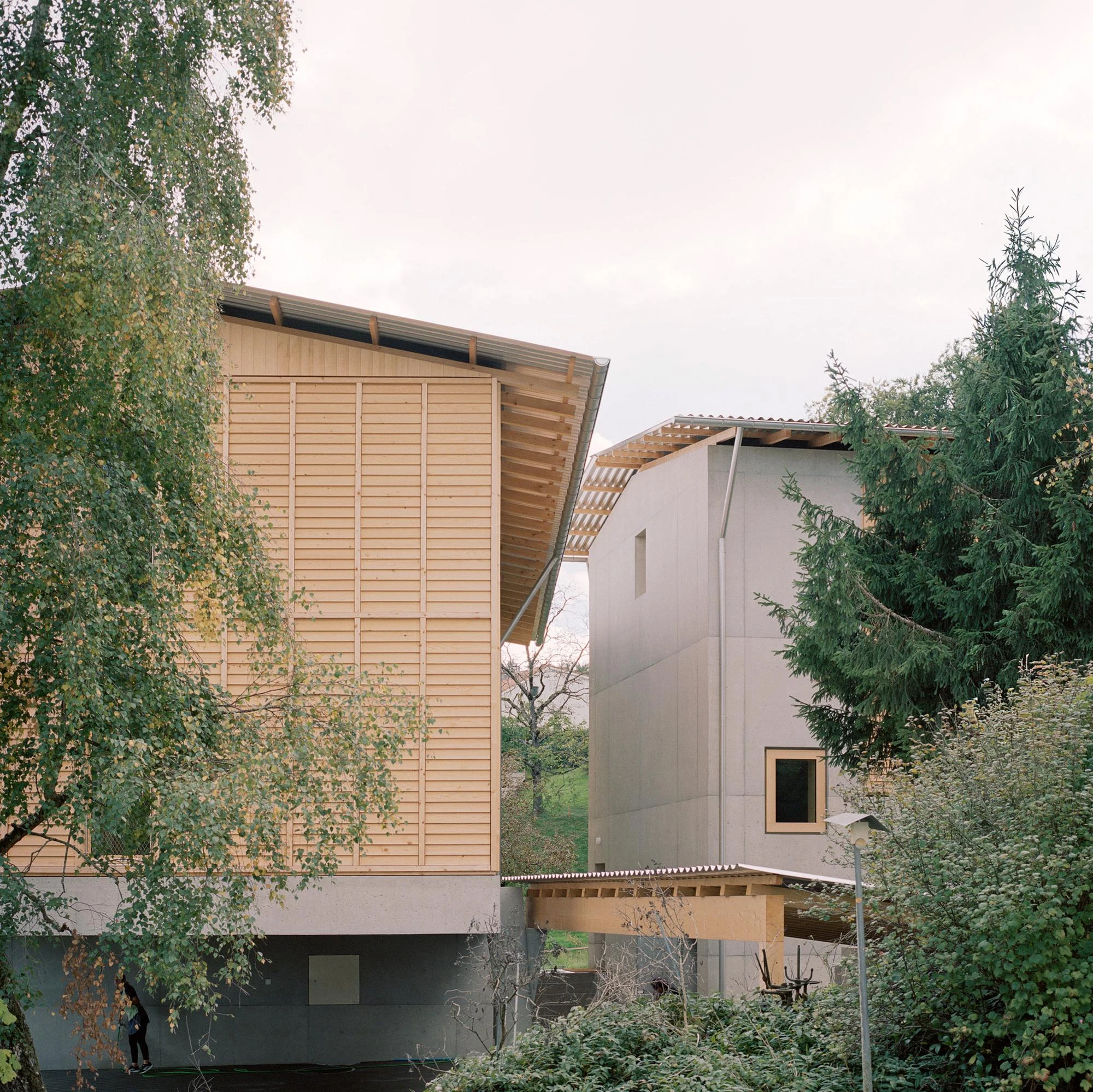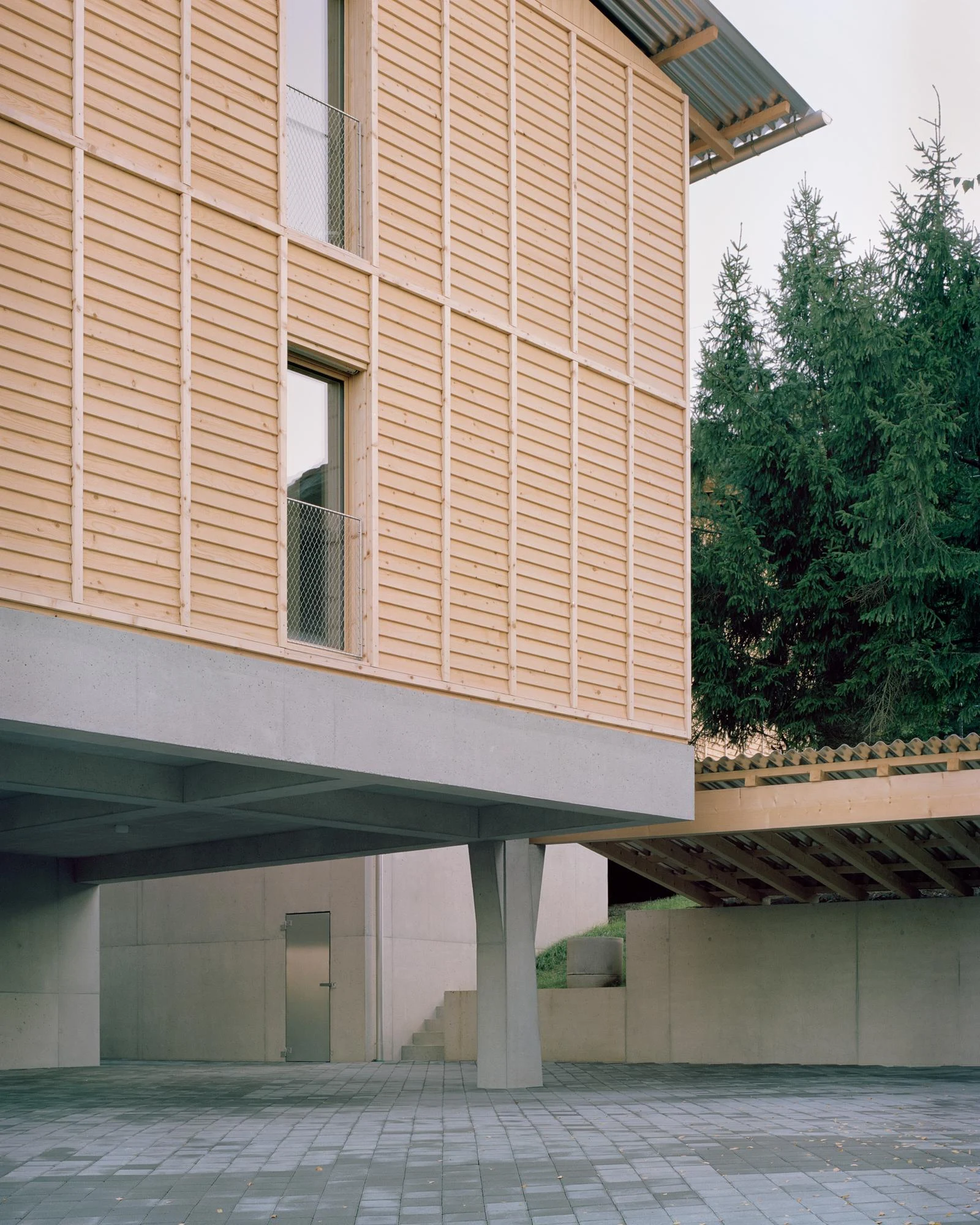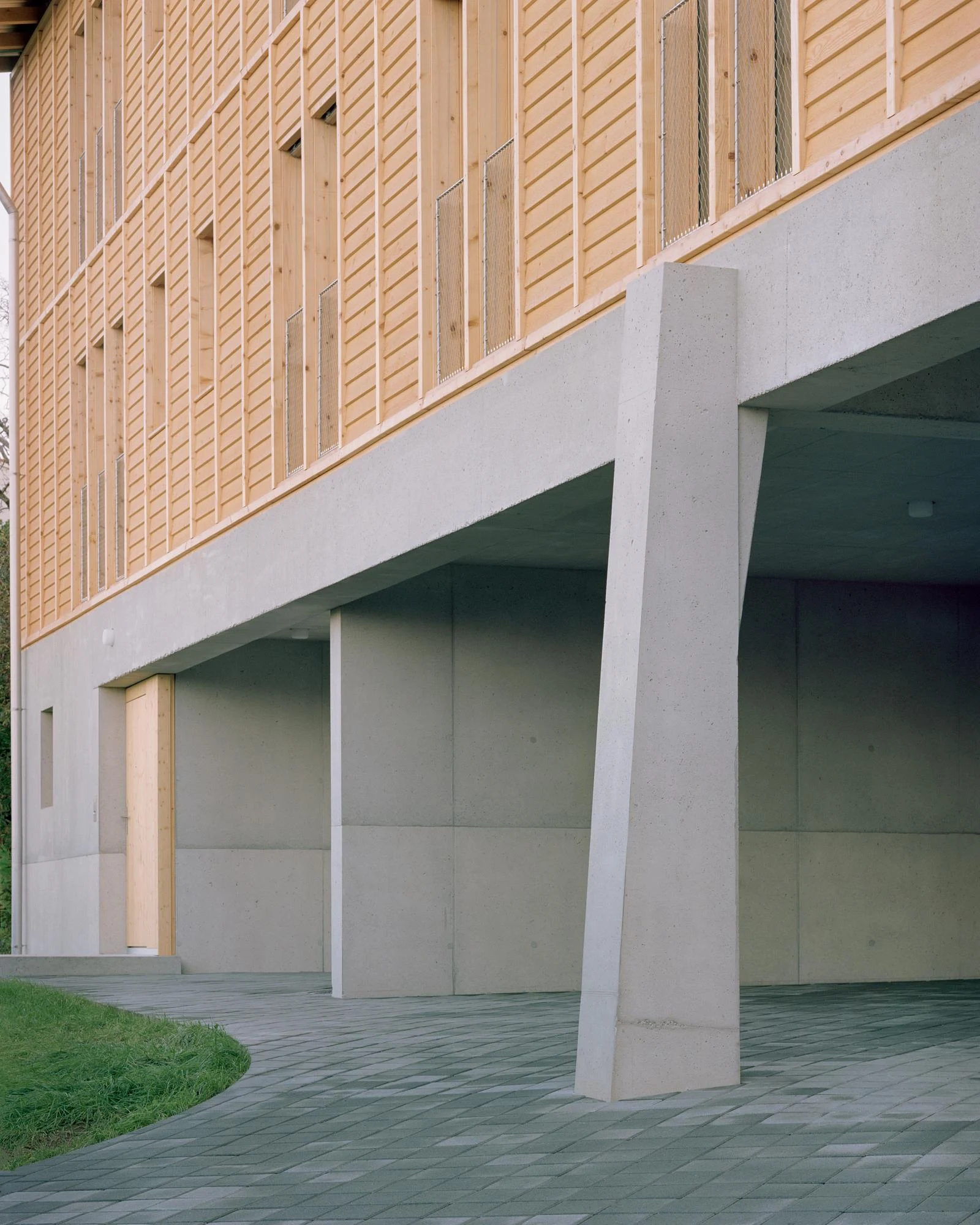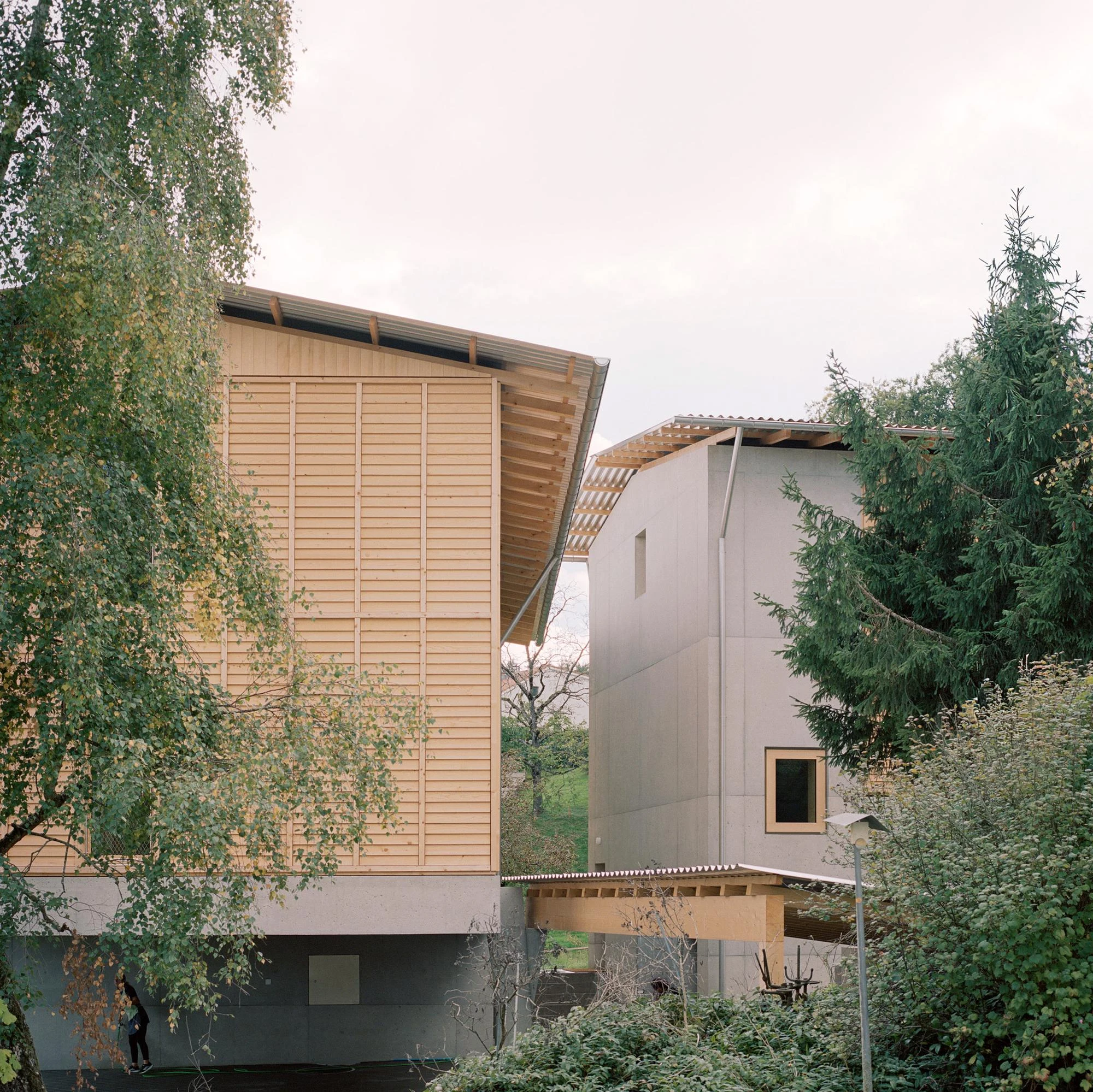
In Courtepin, Fribourg, Deschenaux Architectes completes Hameau des Marais, a residential grouping where board-formed concrete pilotis and larch-louvered facades hold dwellings lined in solid spruce.
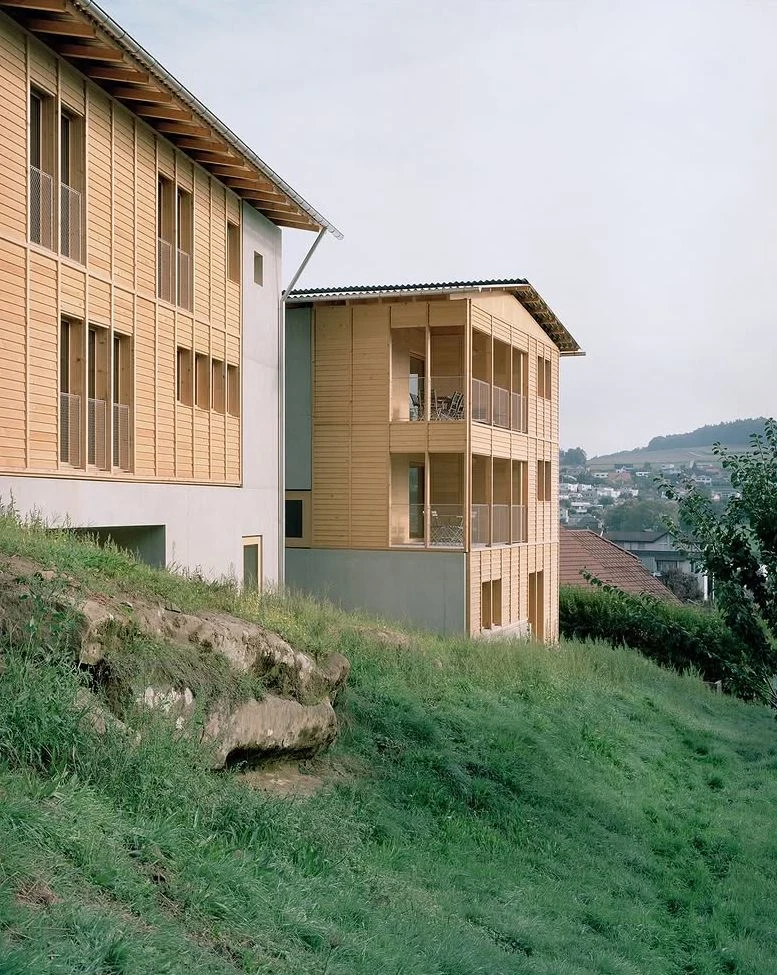
The site sits at the edge of a small Swiss Mittelland community, somewhere between agricultural field and suburban fabric, a condition the studio describes as between countryside, city and mountain. Rather than resolve this ambiguity, Deschenaux Architectes builds from it. The two buildings occupy a gentle slope, one raised on board-formed concrete pilotis above the shared courtyard, the other stepping into the hillside, each clad in horizontal larch louvers that weather from honey to silver.
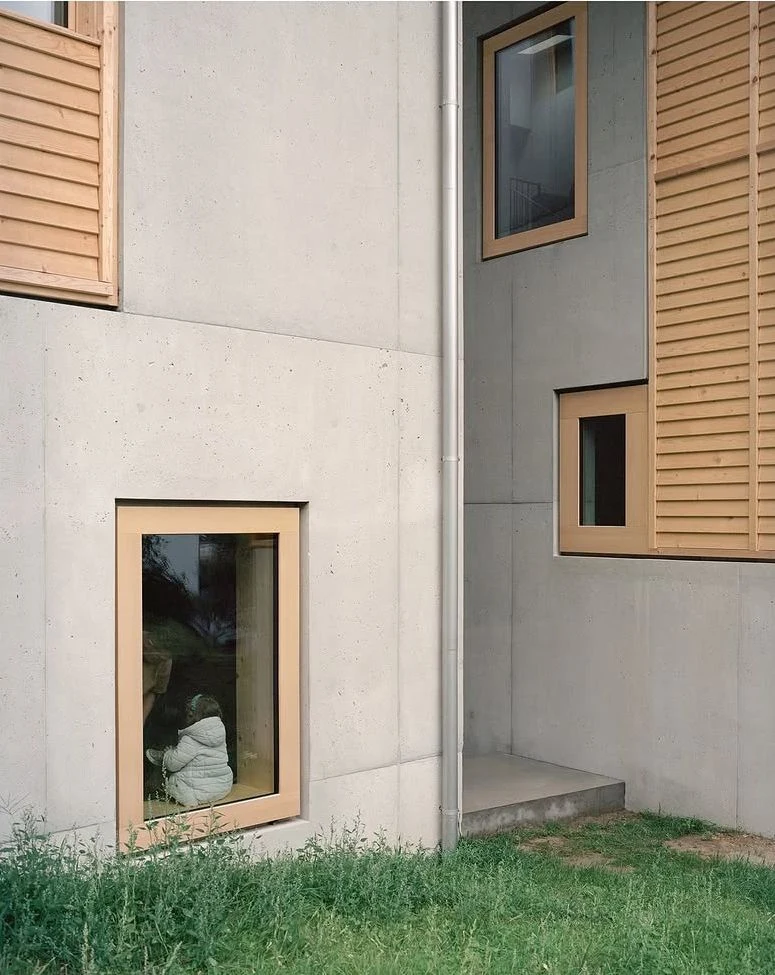
From the outside the concrete reads clearly: the board-form panels are large-format, the joint lines regular, the pilotis tapered slightly from base to capital. The larch louvers above are fixed on a timber substructure visible at the upper loggia, where the floor-framing and corrugated translucent roof are left exposed. This is not a building that conceals its construction; the detailing throughout treats material logic as the primary design instrument.
Inside the timber volume, the structure is spruce cross-laminated timber throughout. Walls, ceilings, stair treads, kitchen cabinetry, and door leaves are all in the same unfinished spruce, the knots and grain continuous from one surface to the next. The kitchen in one apartment sets spruce cabinetry against a stainless steel splashback and worktop; the floor is polished concrete, keeping the ground plane cold and hard against the warm spruce above. In the loggia, the spruce shutters fold back on diagonal bracing, the entire corner opening to the slope and the Mittelland horizon beyond.
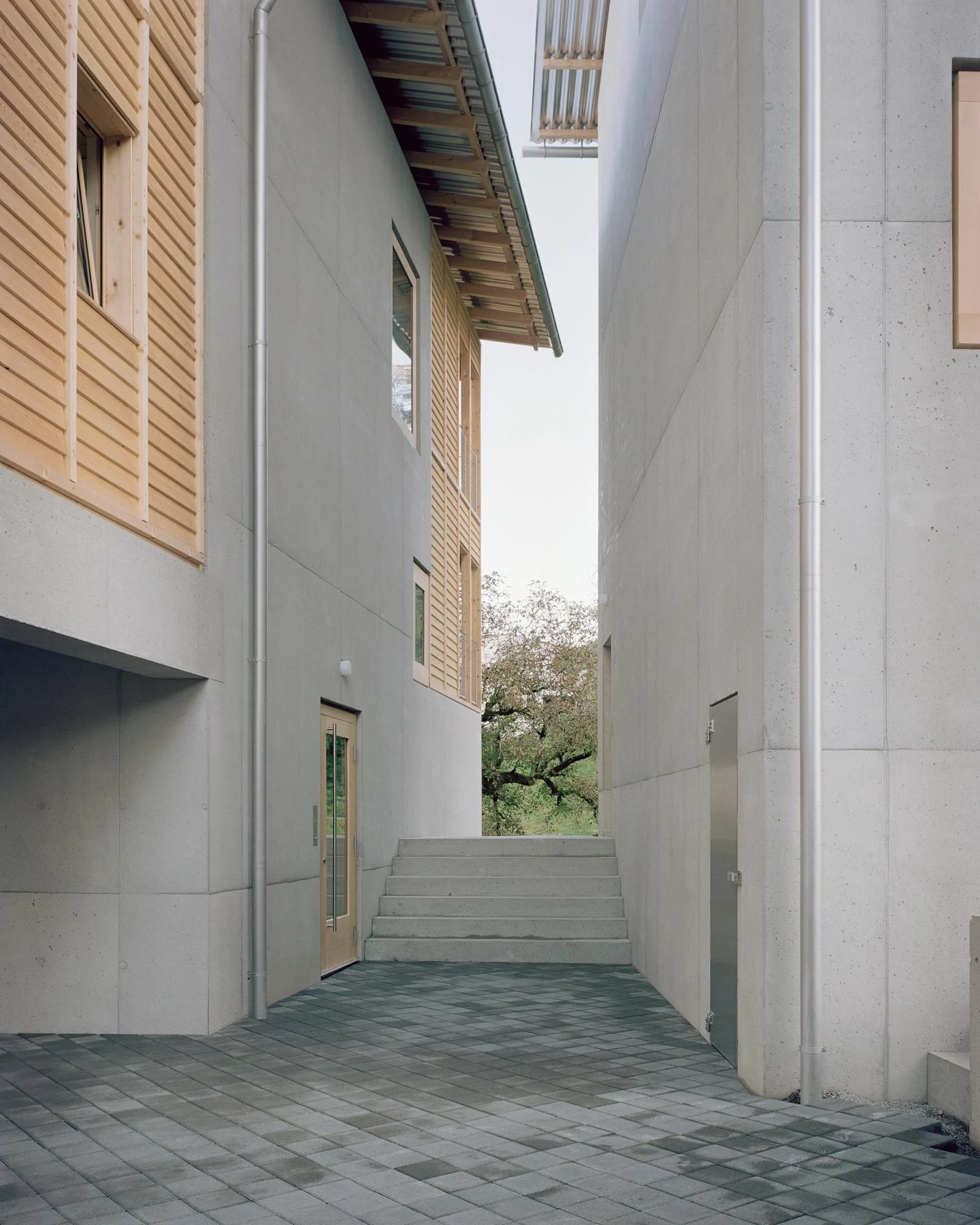
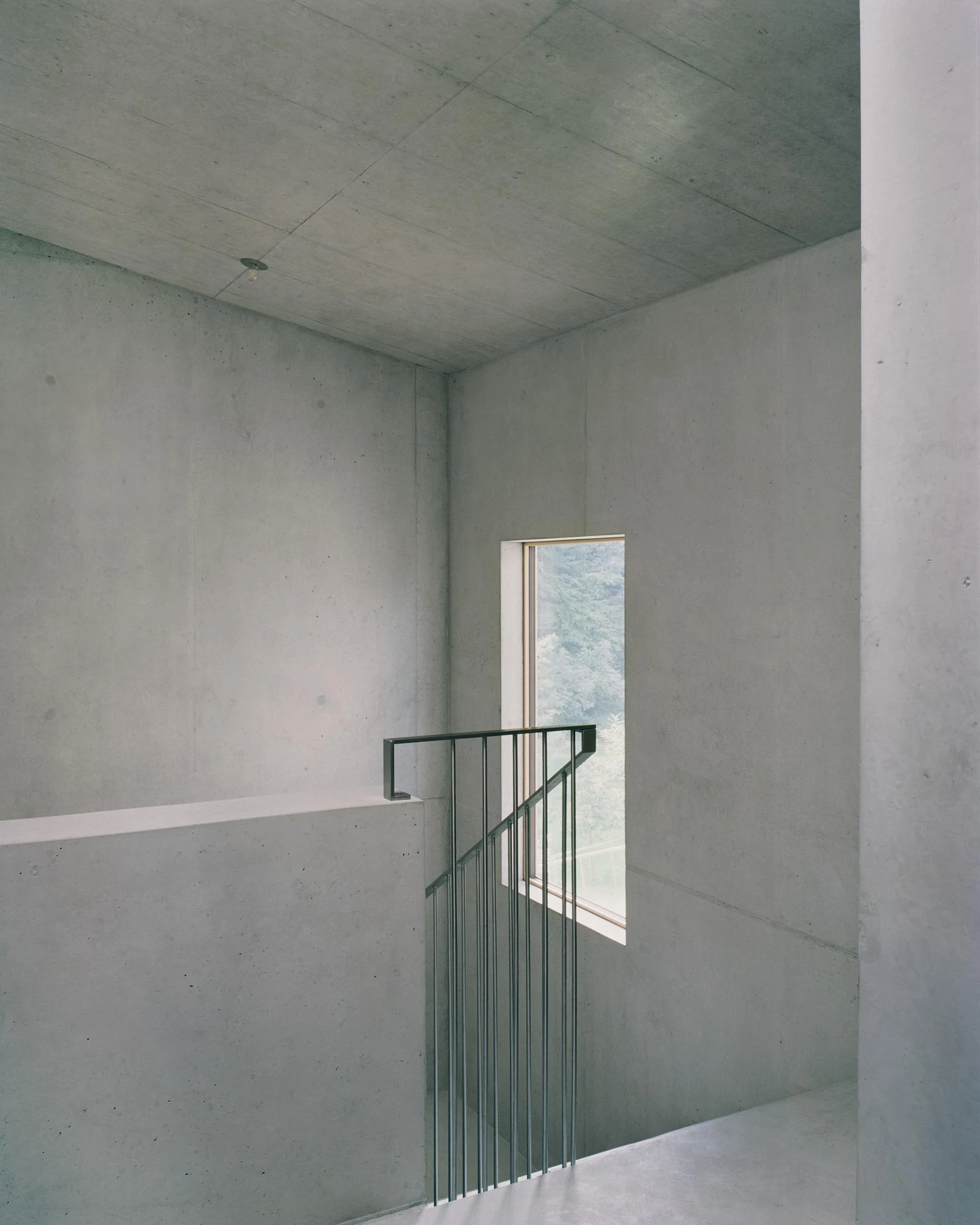
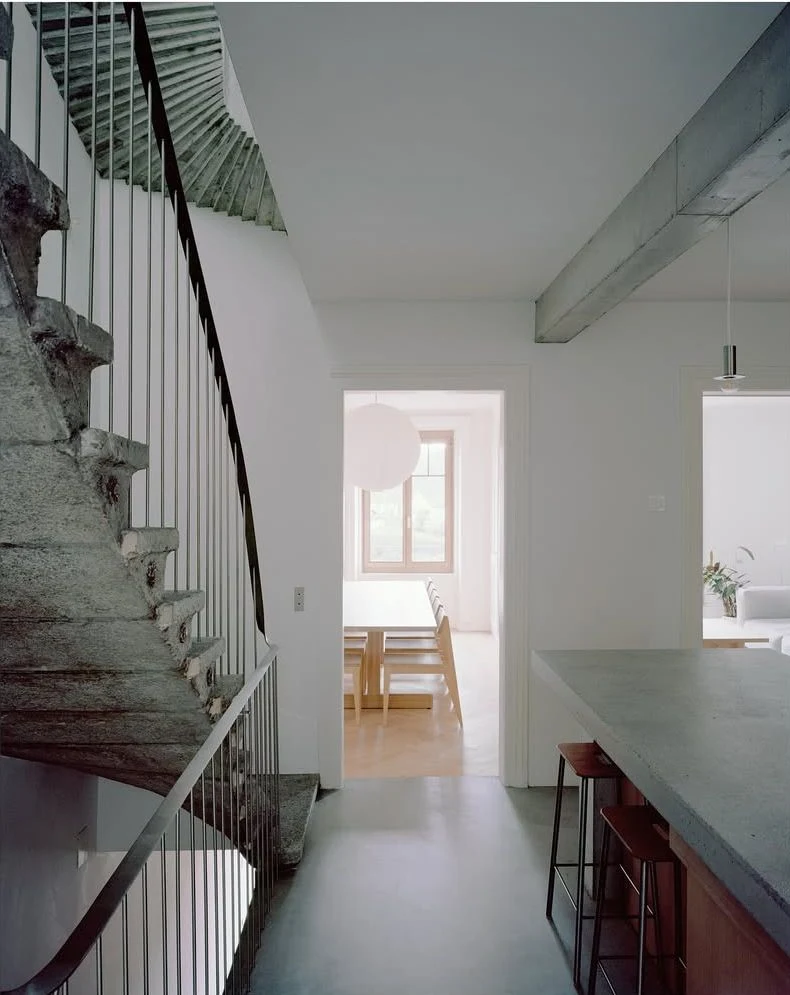
The lower building works differently. A stone stair case carries occupants from street level up; inside, polished concrete floors and exposed beam soffits shift the register toward something heavier, the timber used sparingly as a warm counterpoint rather than the dominant material. A concrete kitchen island with a timber base frames the living zone, a pendant lamp the only addition to a room whose surfaces do all the work.
Between the two volumes the courtyard is paved in small-format concrete block, the same grey as the structure above. Concrete steps lead from the lower courtyard up past the pilotis toward the garden on the slope. A child is visible in one of the photographs, standing by the gate below the building; the scale of the pilotis above, caught at low angle, makes the structure seem more like infrastructure than domestic construction.
Hameau des Marais belongs to a strain of Swiss residential work in which material directness is its own argument: no cladding, no applied finish, no gap between the thing and what it is made of. The pairing of fair-face concrete and unfinished spruce is not a compositional choice so much as a statement about how buildings should be honest about their structure, from the ground up.