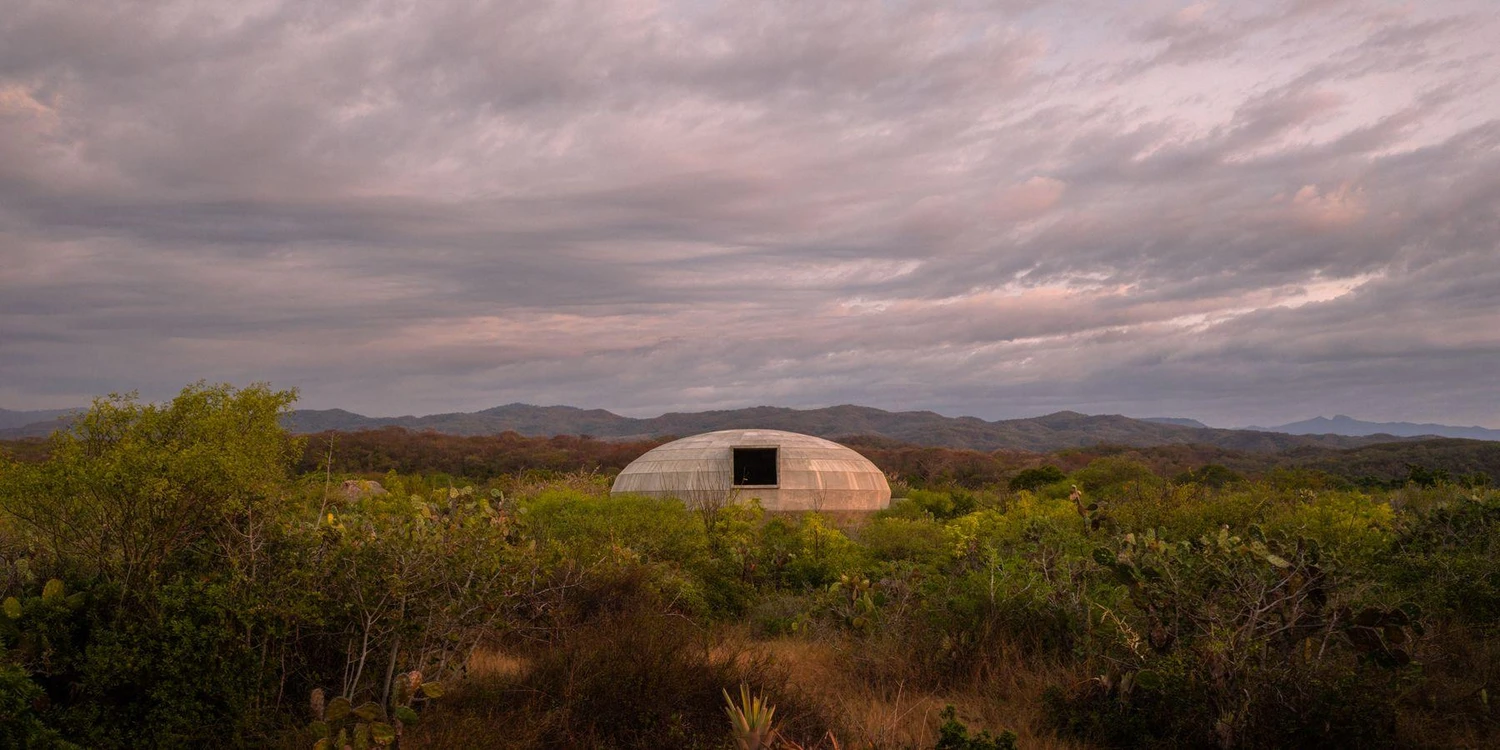
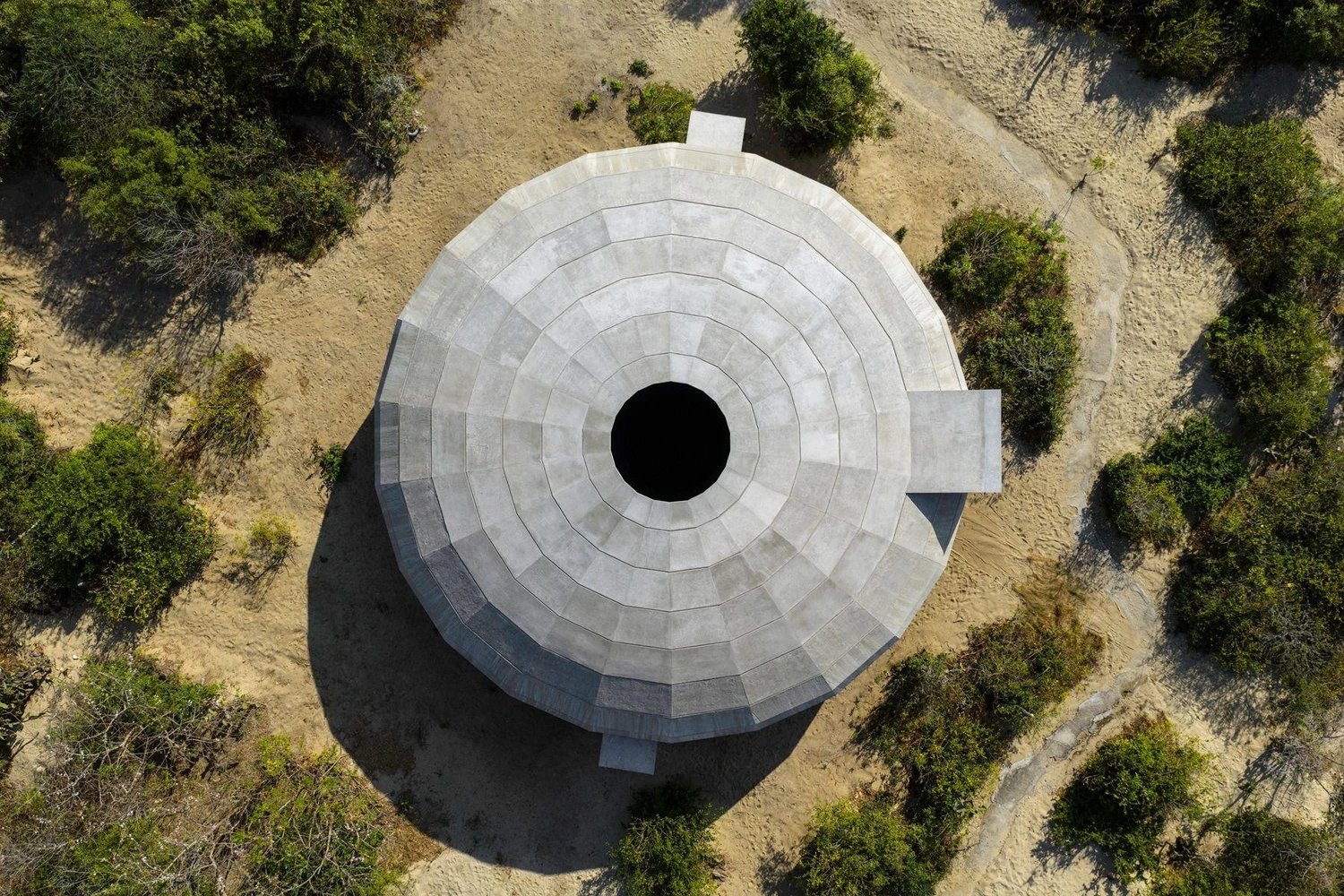
On the 65-acre coastal campus of Fundación Casa Wabi in Puerto Escondido in Mexico, OMA has completed its first building in Mexico—a compact pavilion devoted to mushroom cultivation and communal exchange. Conceived by partner Shohei Shigematsu, the structure takes the form of a self-supporting ellipsoid, like what the architect calls "a basic, oval form," an incubating egg settled between mountains and the Pacific Ocean.
The domed interior divides into three chambers—fruiting room, incubation room, and storage—encircling a central gathering space. Its lower half steps downward like an amphitheatre, with terraced shelving for handmade terracotta pots crafted by local artisans. The arrangement creates what OMA describes as a panopticon experience: the entire cultivation process remains visible from any position inside. An oculus at the apex opens to the sky, filling the cave-like interior with shifting light throughout the day, while peripheral openings at the base draw in natural ventilation from the coast.
The material strategy is characteristically deliberate. The poured-in-place concrete shell bears a burlap-stamped exterior texture that retains the site’s iron-rich water—meaning the building will slowly rust and transform in appearance over time. It curves inward at the base to minimise ground contact, preserving the landscape around a native guayacan tree. The harvested mushrooms feed directly into the kitchens of the foundation and nearby Hotel Escondido, closing a loop between architecture, agriculture, and daily life.
"Working with Bosco Sodi and Fundacion Casa Wabi, we conceived a pavilion for the very specific function of mushroom cultivation while offering a space for people to come together," Shigematsu reflects. "As a Japanese architect, it was especially meaningful to contribute an art campus guided by Japanese philosophy and spatial traditions." The Mushroom Pavilion joins an extraordinary lineage on the property—Alvaro Siza’s Clay Pavilion, Kengo Kuma’s Chicken Coop—yet holds its own through sheer conviction: a building that incubates both food and community, and asks nothing in return but time.