Thisispaper Community
Join today.
Enter your email address to receive the latest news on emerging art, design, lifestyle and tech from Thisispaper, delivered straight to your inbox.
Oops! Something went wrong while submitting the form.
Instant access to new channels
The top stories curated daily
Weekly roundups of what's important
Original features and deep dives
Exclusive community features
Alexander Zaxarov
Apr 29, 2026

In a narrow street of Triggiano, near Bari in Apulia, Italy, Giovanni Rucci opens one of two original vaults of a derelict early 20th-century house to create Casa Verri, a six-metre patio hidden behind a listed facade.

Casa Verri sits on a narrow street at the edge of Triggiano, a village in the flat country south of Bari. From the pavement nothing appears to have changed: a rendered beige facade with arched windows, a dark door, the faint decorative cornice of an early 20th-century townhouse the local authorities have listed for preservation. The intervention is entirely internal, invisible to neighbours and passers-by, and that is the point.

The original house had been abandoned for years. Two large vaulted rooms ran deep into the block, blind on three sides, with a single frontage onto the street. The interiors were barely habitable, the darkness almost total. Photographer Federico Farinatti documents what Rucci inherited and what he made of it: a dwelling that had lost any relationship to light.

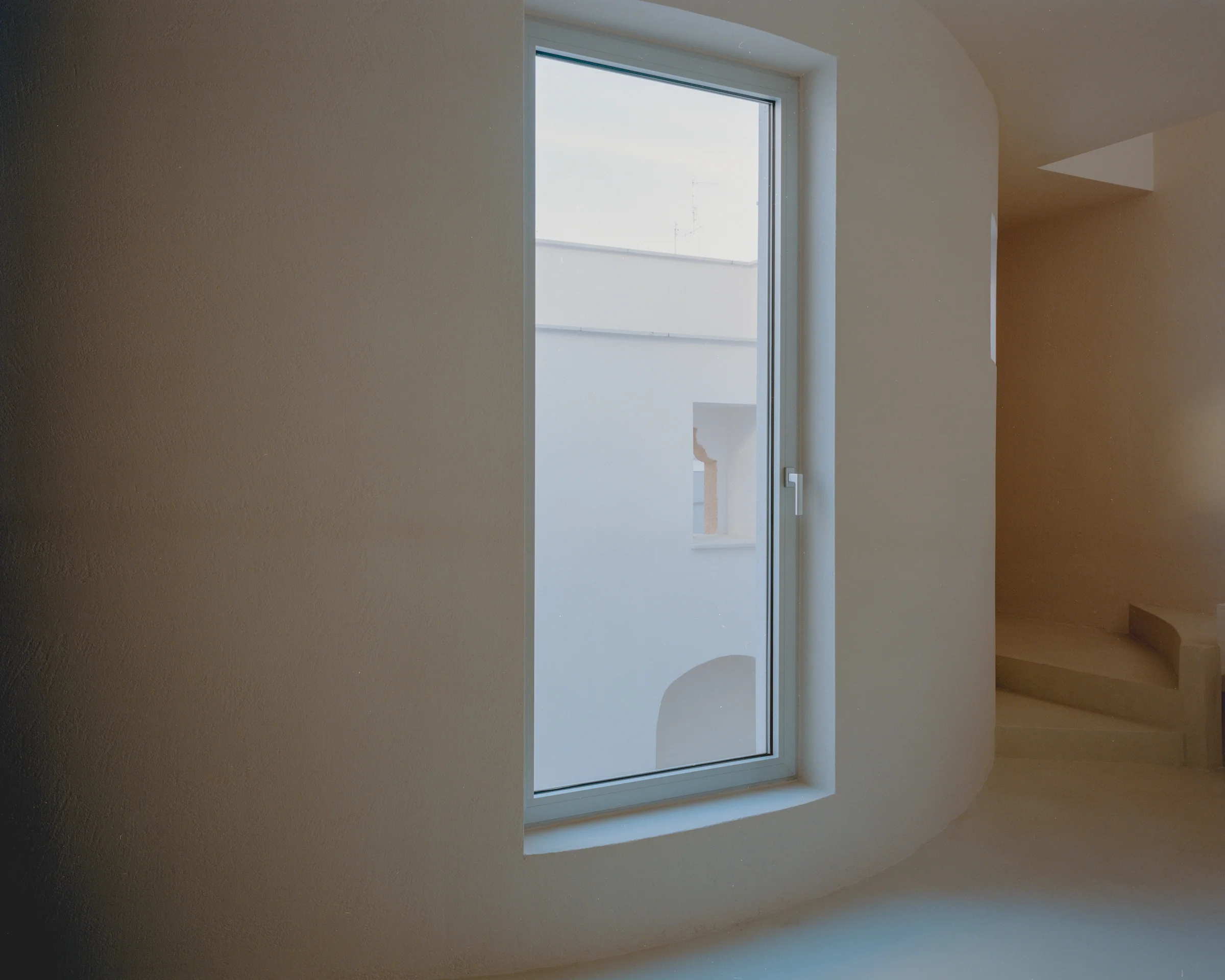
In close consultation with the municipal heritage office, Rucci removed one of the two vaults. The subtraction produced a patio, six metres high, invisible from the street and sunk into the plan at the centre of the house. Around it, old and new spaces now organise themselves across two floors, living rooms on the ground, a workspace above. The void does what the listed facade would not permit: it admits the sky.

The patio is finished in white render, its walls curving in elliptical section to soften the geometry of the cut. Pale terracotta pavers line the floor. A single folding chair and a draped burgundy cloth are the only furnishings needed to register the passage of the sun: in the images the shadow of the parapet sweeps across the render like a giant sundial, deep at one edge and cream-bright at the other. In summer the curve offers shade; in winter it funnels low Apulian light into the bedrooms.

The interiors address the new court with restraint. Floor-to-ceiling sliding panels in frameless glass and opaque cream plaster alternate across a herringbone-tiled threshold. A round dining table is set in an alcove cut from whitewashed render, a corridor leads past burgundy joinery to a bedroom on a sage-green base, a curved archway marks the transition to a bathroom of burgundy cabinets and terrazzo. The palette is narrow: plaster, cream tile, terracotta, two lacquered accents of burgundy and green. Nothing competes with the void.

Seen from the roof at dusk, the parapet of the patio rises from the terrace as a single curved lip of ochre render, catching the last light while television aerials and stacked balconies press in on every side. Casa Verri never announces itself on the street. The house is now organised around a piece of sky that the neighbours cannot see, a quiet act of planning that treats the listed facade not as a constraint but as a cover story.

Interested in Showcasing Your Work?

If you would like to feature your works on Thisispaper, please visit our Submission page and sign up to Thisispaper+ to submit your work. Once your submission is approved, your work will be showcased to our global audience of 2 million art, architecture, and design professionals and enthusiasts.
No items found.
We love less
but there is more.
Become a Thisispaper+ member today to unlock full access to our magazine, advanced tools, and support our work.
Get two months FREE
with annual subscription
We love less
but there is more.
Become a Thisispaper+ member today to unlock full access to our magazine, advanced tools, and support our work.
Get two months FREE
with annual subscription
No items found.
Alexander Zaxarov
Apr 29, 2026

In a narrow street of Triggiano, near Bari in Apulia, Italy, Giovanni Rucci opens one of two original vaults of a derelict early 20th-century house to create Casa Verri, a six-metre patio hidden behind a listed facade.

Casa Verri sits on a narrow street at the edge of Triggiano, a village in the flat country south of Bari. From the pavement nothing appears to have changed: a rendered beige facade with arched windows, a dark door, the faint decorative cornice of an early 20th-century townhouse the local authorities have listed for preservation. The intervention is entirely internal, invisible to neighbours and passers-by, and that is the point.

The original house had been abandoned for years. Two large vaulted rooms ran deep into the block, blind on three sides, with a single frontage onto the street. The interiors were barely habitable, the darkness almost total. Photographer Federico Farinatti documents what Rucci inherited and what he made of it: a dwelling that had lost any relationship to light.

In close consultation with the municipal heritage office, Rucci removed one of the two vaults. The subtraction produced a patio, six metres high, invisible from the street and sunk into the plan at the centre of the house. Around it, old and new spaces now organise themselves across two floors, living rooms on the ground, a workspace above. The void does what the listed facade would not permit: it admits the sky.

The patio is finished in white render, its walls curving in elliptical section to soften the geometry of the cut. Pale terracotta pavers line the floor. A single folding chair and a draped burgundy cloth are the only furnishings needed to register the passage of the sun: in the images the shadow of the parapet sweeps across the render like a giant sundial, deep at one edge and cream-bright at the other. In summer the curve offers shade; in winter it funnels low Apulian light into the bedrooms.

The interiors address the new court with restraint. Floor-to-ceiling sliding panels in frameless glass and opaque cream plaster alternate across a herringbone-tiled threshold. A round dining table is set in an alcove cut from whitewashed render, a corridor leads past burgundy joinery to a bedroom on a sage-green base, a curved archway marks the transition to a bathroom of burgundy cabinets and terrazzo. The palette is narrow: plaster, cream tile, terracotta, two lacquered accents of burgundy and green. Nothing competes with the void.

Seen from the roof at dusk, the parapet of the patio rises from the terrace as a single curved lip of ochre render, catching the last light while television aerials and stacked balconies press in on every side. Casa Verri never announces itself on the street. The house is now organised around a piece of sky that the neighbours cannot see, a quiet act of planning that treats the listed facade not as a constraint but as a cover story.

Interested in Showcasing Your Work?

If you would like to feature your works on Thisispaper, please visit our Submission page and subscribe to Thisispaper+. Once your submission is approved, your work will be showcased to our global audience of 2 million art, architecture, and design professionals and enthusiasts.
No items found.

Join Thisispaper+
Unlock access to 2500 stories, curated guides + editions, and share your work with a global network of architects, artists, writers and designers who are shaping the future.
Get two months FREE
with annual subscription
Travel Guides
Immerse yourself in timeless destinations, hidden gems, and creative spaces—curated by humans, not algorithms.
Explore All Guides +
Submission Module
Submit your project and gain the chance to showcase your work to our worldwide audience of over 2M architects, designers, artists, and curious minds.
Learn More+
Curated Editions
Dive deeper into carefully curated editions, designed to feed your curiosity and foster exploration.
Off-the-Grid
Jutaku
Sacral Journey
minimum
The New Chair
Explore All Editions +
Atlas
A new and interactive way to explore the most inspiring places around the world.
Interactive map
Linked to articles
300+ curated locations
Google + Apple directions
Smart filters
Subscribe to Explore+
Become a Thisispaper+ member today to unlock full access to our magazine, submit your project and support our work.
Join Thisispaper+Join Thisispaper+
€ 9 EUR
/month
Cancel anytime
Get two months FREE
with annual subscription