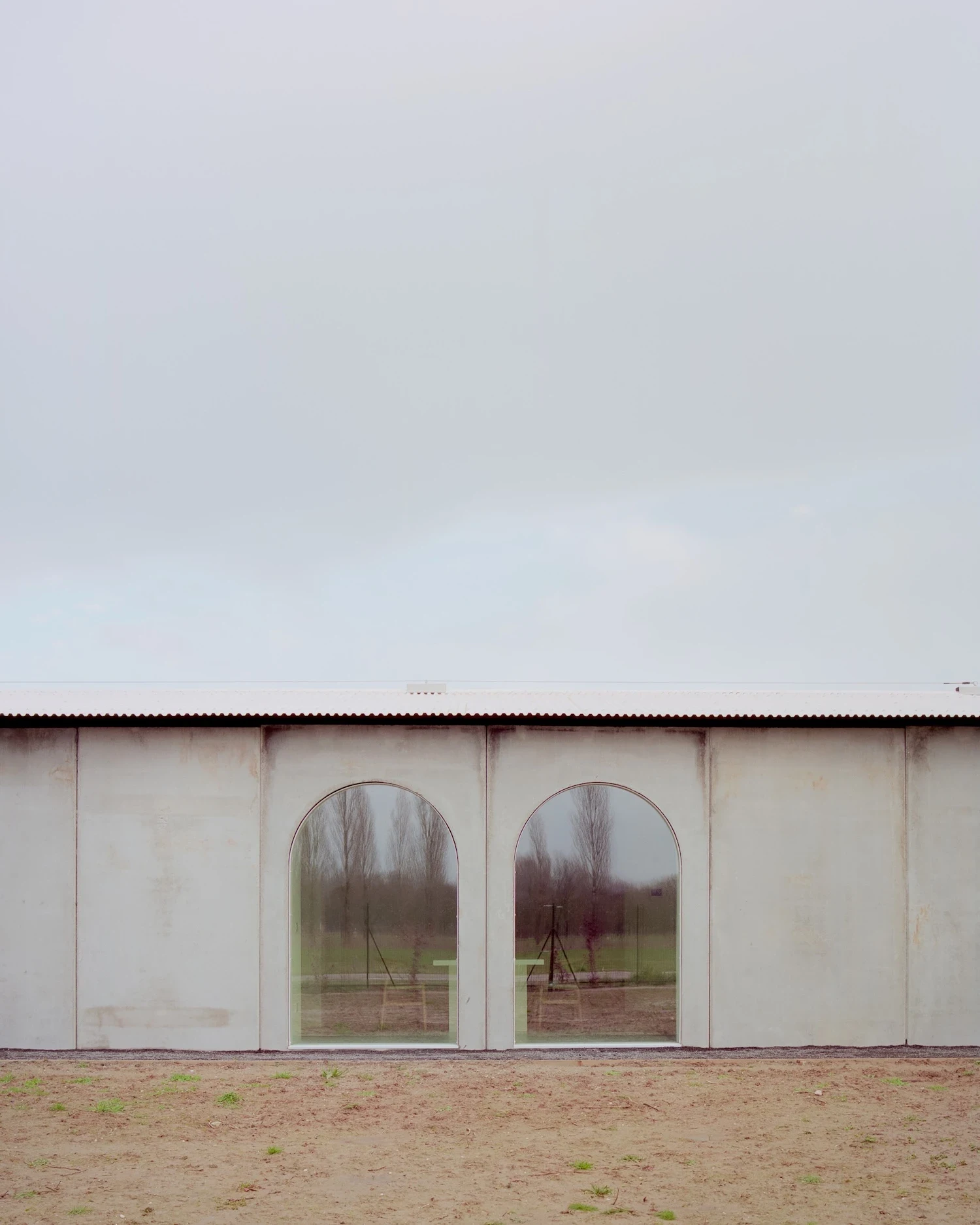
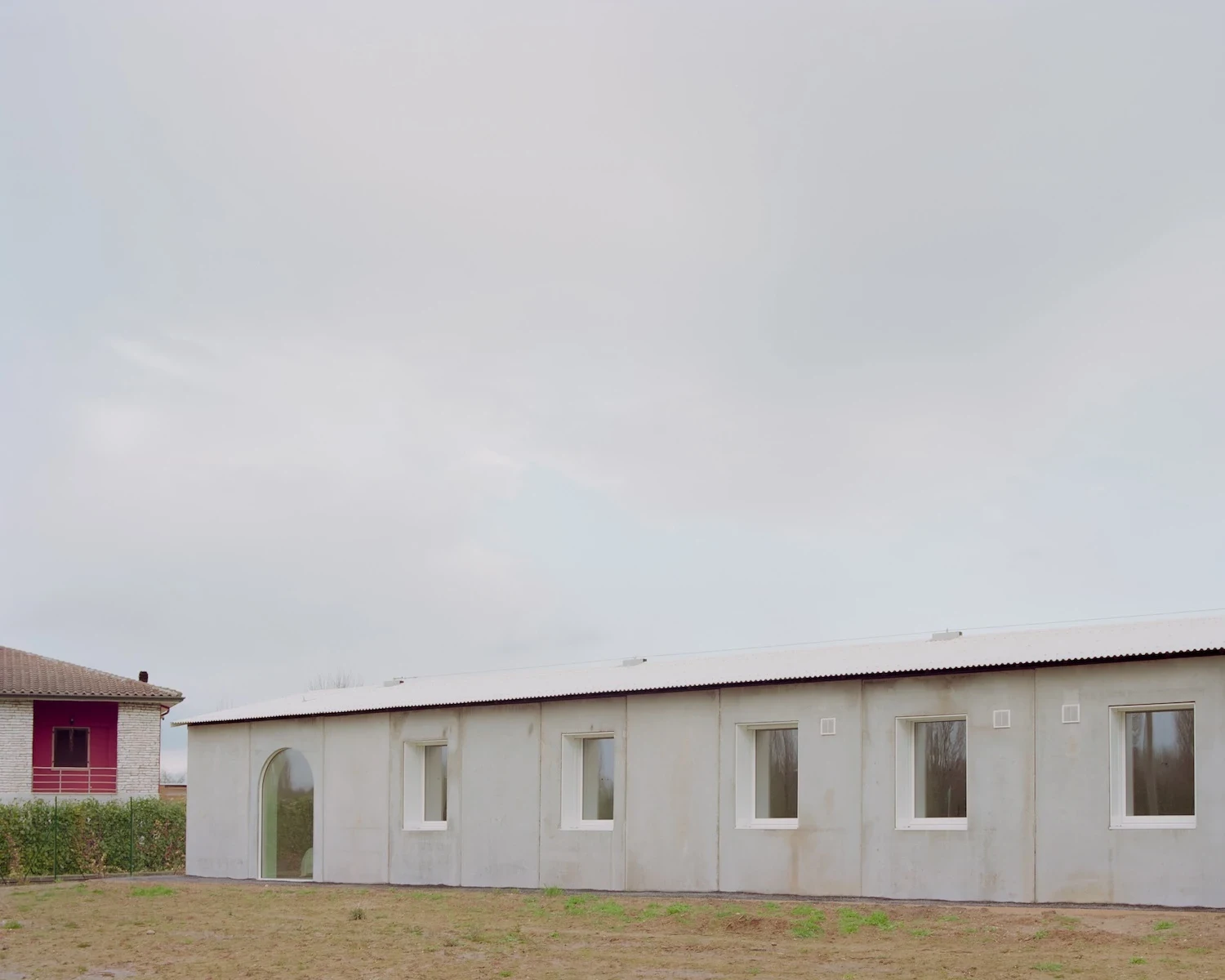
In the Po Valley flatlands of Gazzo Bigarello, Italy, Archiplan Studio builds Casa GA from prefabricated concrete panels — a house that reinterprets the elementary rural forms of this agricultural landscape.
The Po Valley is not a dramatic landscape. It is flat, open, and structured by decades of agricultural logic: long low forms, pitched roofs, unpretentious utility. Casa GA does not resist this. It inhabits the tradition honestly, using a prefabricated concrete system to produce something that could, in silhouette, be mistaken for a centuries-old rural structure. That continuity is deliberate and considered.
The exposed concrete panels carry their texture openly: formwork marks, slight tonal variation between panels, "raw, tactile" surfaces that come from a material not asked to pretend it is something else. Above, the white sheet metal roof reads against the panels with the kind of tonal contrast that belongs to agricultural vernacular, where roofing materials were always distinct from walls. The exterior is austere; the interior, by contrast, delivers "warmth and spatial generosity."
There is a principle of concealment and revelation at work throughout. Industrial materials serve as a threshold before entering refined domestic spaces. The combination is precise without being precious, tactile without the fetishizing of craft that can make raw-material architecture feel performative. Photographer Simone Bossi documents the house at the scale of the landscape and the scale of the concrete grain, holding both readings simultaneously.
There is a certain intelligence in choosing prefabrication for a project that aims at vernacular continuity. The Po Valley barn was never built slowly or expensively; it was built efficiently, with available means. Casa GA respects that economy of means while arriving at something architecturally complete — a concrete house that belongs to its place precisely because it was made the way things here have always been made.